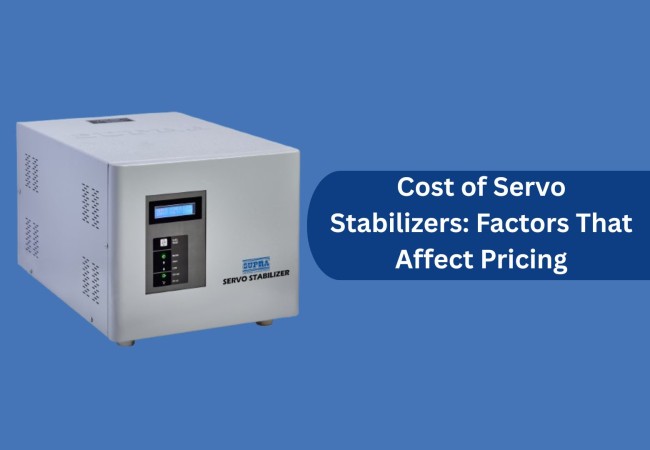
Ever thought about how a servo stabilizer reacts so fast when voltage keeps jumping up and down? It’s one of those things people don’t notice until something goes wrong. A servo stabilizer works by constantly checking the incoming voltage and correcting it when needed. A motor-driven system adjusts the transformer whenever voltage changes, bringing it back to a stable level. This keeps your equipment safe and running smoothly. However, the cost of servo stabilizers can vary significantly.
Understanding the factors that affect servo stabilizer cost can help you avoid spending too much or buying a stabilizer that doesn't suit your operations. In this blog, we’ll break down what influences pricing and how to choose the right unit.
1. Capacity and Load Requirements
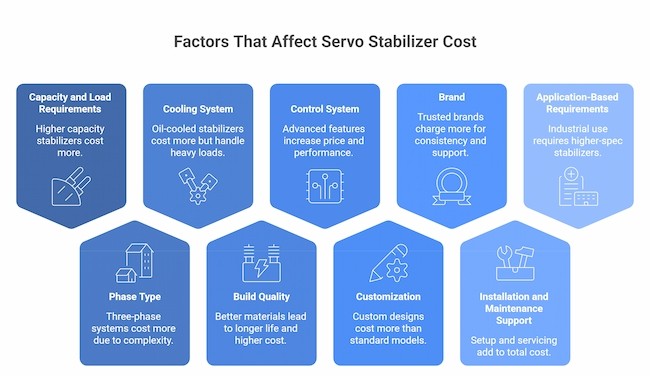
The first thing that affects cost is capacity, which is measured in kVA. A stabilizer for a small office setup is obviously going to cost less than one used for heavy industrial machines. For example, a 5 kVA unit for home use is usually compact and not too expensive. But once you get into 50 kVA or 100 kVA units for industrial use, the price goes up because they need bigger transformers, stronger parts, and better cooling. It’s not just about budget either. If the stabilizer is too small, it won’t handle the load. Too big, and you’re just spending extra for no real reason.
2. Single-Phase vs. Three-Phase Stabilizers
Another key factor that affects the cost is the type of power supply. Single-phase stabilizers are functionally simpler with fewer parts inside and are used in homes or small businesses. This makes them the most affordable option. Three-phase stabilizers are built for industrial environments where machines run continuously. These are more complex, with additional components and protection systems. Naturally, that makes them more expensive.
Also read: Single-Phase or Three-Phase Stabilizers Which Is Right for Your Needs?
3. Stabilizer Cooling System
Cooling and overall heat management play a major role in both the pricing and performance of a stabilizer. Air-cooled stabilizers are common for medium-level usage. They’re simpler and easier on the budget, making them the ideal option for commercial and light industrial uses.
Oil-cooled stabilizers, on the other hand, are used in heavier applications. They handle heat dissipation better and are built for long hours of operation. Because of their high efficiency and complex design, they usually cost more than air-cooled models.
4. Build Quality and Internal Components
Not all stabilizers are built the same. The quality of materials used makes a noticeable difference in both performance and price. Better copper windings, solid transformers, and reliable internal parts mean better efficiency and longer life. These components also improve accuracy in voltage correction and reduce maintenance requirements. However, cheaper models may skimp on this, lowering the initial cost, leading to more maintenance down the road.
5. Control System and Features
Some industries need stabilizers designed for specific conditions, like unusual voltage ranges or tough environments. Advanced models include microprocessor-based control systems that improve accuracy and response time. Additional features such as digital displays, overload protection, short circuit protection, and automatic cut-off functions further increase cost but improve safety and usability.
6. Capacity and Load Requirements
Not every stabilizer setup is standard. Customization of stabilizers has become common in the modern world to face varying voltage ranges and special enclosure types for harsh environments. Some applications may also require unique installation layouts or operational settings. Since customized units require additional design and manufacturing effort, they are usually more expensive than standard models.
7. Brand and Manufacturer Reputation
Brand reputation is a core factor affecting the pricing of servo stabilizers. Well-known manufacturers usually charge more because they invest in testing, quality control, and consistent production. Less established brands may offer lower prices, but they often fail to provide the same level of quality assurance, service support, or product consistency.
8. Installation and Maintenance Support
The total cost of a stabilizer doesn’t end with the initial purchase. Larger units often need proper installation and setup, which adds to the expense. Maintenance is another factor. Some stabilizers are easier to service than others. Paying a bit more upfront for a low-maintenance unit can save effort and cost later.
Read more: How to Find the Right Servo Stabilizer Manufacturer and Supplier for Your Business Needs
9. Application-Based Requirements
Where you plan to use the stabilizer matters a lot. Industries like healthcare, manufacturing, and IT depend heavily on stable power. In these cases, stabilizers need to be more accurate and responsive, with stronger components. That naturally pushes the price higher.
Supra - Your Power Control Technology Partner for Best Servo Stabilizers
The price of a servo stabilizer is shaped by a combination of technical, material, and brand-related factors. Capacity, phase type, cooling system, winding material, voltage range, regulation accuracy, technology features, and build quality all play a role in determining what you pay. Being aware of these factors allows you to evaluate options clearly and invest in a product that genuinely serves your needs.
If you are looking for high-quality servo stabilizers backed by decades of engineering expertise, Supra Hi-Tech is a name worth knowing. As a leading manufacturer of advanced power control and backup solutions, we offer a trusted range of servo stabilizers designed for businesses and industrial applications. Our products are built to deliver consistent voltage regulation, long operational life, and reliable protection for your equipment.
Get in touch with us today to find out more about our servo stabilizers. Let us help you find the right power control technology!