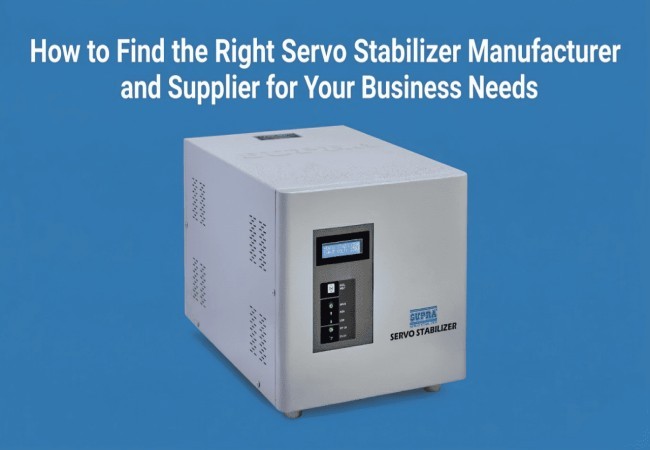
Stable power is essential for modern businesses that rely on sensitive machinery and electronic equipment. Voltage fluctuations, sudden power dips, and electrical surges can damage expensive machines, interrupt production, and increase operational costs. A servo voltage stabilizer plays a crucial role in protecting equipment by maintaining a consistent voltage supply.
However, the effectiveness of a stabilizer depends largely on the manufacturer and supplier you choose. Selecting the right partner ensures reliable performance, better durability, and long-term value for your business. This guide will help you understand how to choose the right servo stabilizer manufacturer and supplier for your operational needs.
Understanding the Importance of Choosing the Right Servo Stabilizer Manufacturer
Servo stabilizers are critical power management devices used in industries such as manufacturing, healthcare, data centers, textile production, and commercial facilities. These stabilizers protect sensitive equipment like CNC machines, medical imaging systems, and automated production lines from voltage fluctuations.
Choosing the right manufacturer ensures that your stabilizer is designed with high-quality materials and advanced control systems. A poorly built stabilizer may struggle to respond quickly to voltage changes, which can result in equipment damage, overheating, or operational downtime.
Experienced manufacturers also understand different industry requirements and can recommend the most suitable stabilizer configuration for your power load and working environment. In the long run, selecting a reliable supplier helps businesses maintain productivity, avoid costly repairs, and ensure uninterrupted operations.
What is a Servo Voltage Stabilizer and Why Do Businesses Need It?
A servo voltage stabilizer is an automatic voltage regulation device designed to maintain a stable output voltage regardless of fluctuations in the input power supply. Unlike basic stabilizers, servo stabilizers use a servo motor and control circuit to continuously monitor and adjust voltage levels with high precision. It works with a high-speed servo motor that moves a carbon brush along the windings of a transformer, known as a variac. This design enables the stabilizer to make smooth and continuous voltage adjustments instead of sudden changes. As a result, it provides a very stable output, with precision usually around ±1%, ensuring a consistent and dependable power supply.
For businesses that depend on sensitive or valuable equipment, stability is crucial. Keeping voltage steady protects electronics and machinery from harmful fluctuations that can lead to overheating or damage over time. A servo stabilizer maintains the correct voltage level, helping to extend the lifespan of motors, circuits, and other components. Also, optimized voltage enables machines to draw only the current they need, improving energy efficiency and possibly lowering electricity costs.
Learn more: What Does a Stabilizer Do? Types and Their Unique Functions
Key Factors to Consider When Selecting a Servo Stabilizer Manufacturer
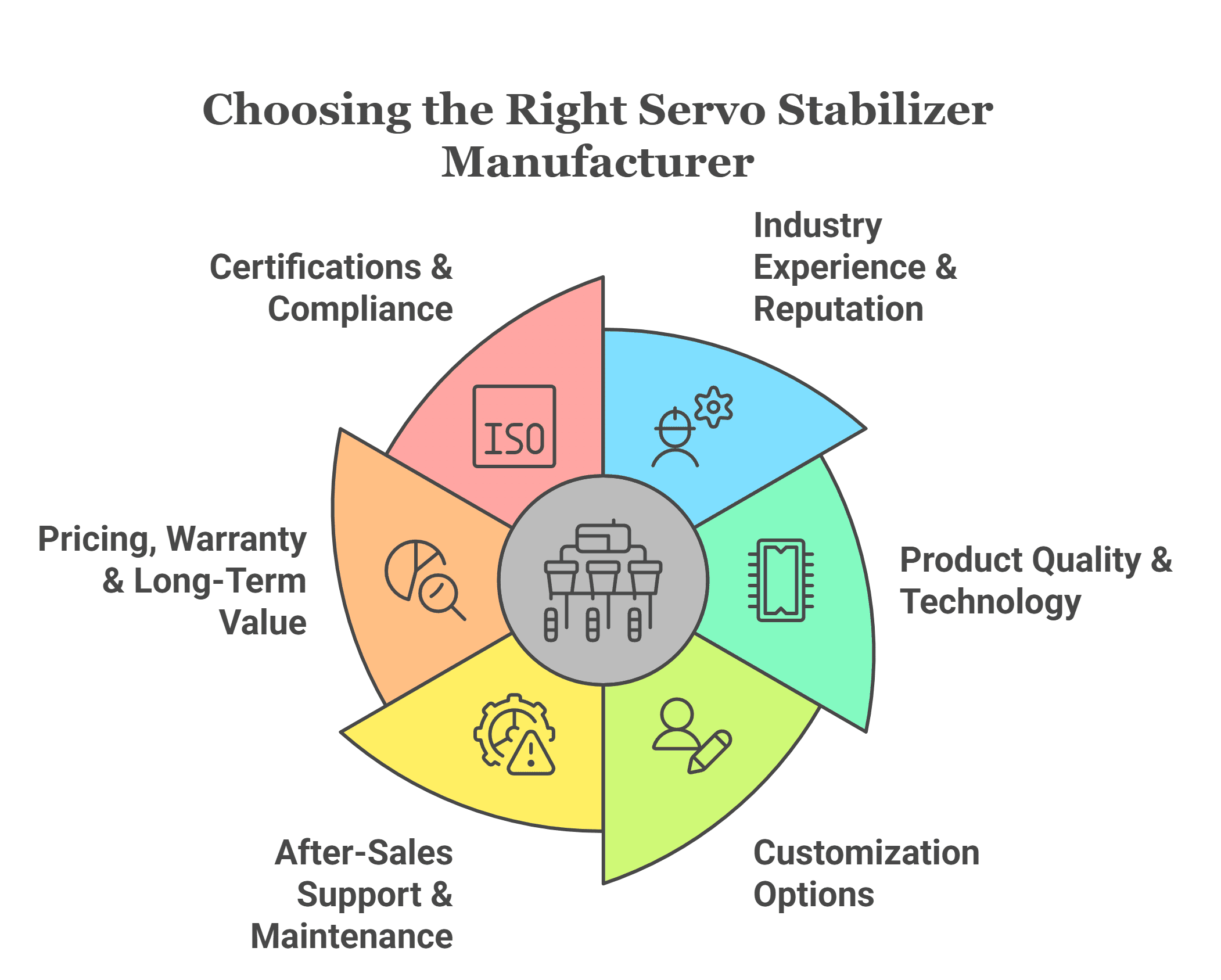
Choosing the right servo stabilizer manufacturer requires careful evaluation of several important factors. Businesses should focus on reliability, engineering quality, and long-term support when selecting a supplier. In a setting where one power surge can disrupt a day's production or harm delicate microprocessors, the engineering quality of the stabilizer acts as your primary defense. By focusing on the following key pillars, you can identify a partner who brings genuine technical expertise to your facility.
1. Check the Manufacturer’s Industry Experience and Reputation
Experience is one of the most important indicators of reliability in power equipment manufacturing. A manufacturer with over 20 years in the field has probably faced every kind of grid problem, from rural brownouts to urban surges. Select a supplier with a solid history in your industry, whether it's supplying power to hospitals or large textile mills. This ensures they can meet your specific needs. Experienced manufacturers do not just sell standard units. They provide systems designed for your facility's load patterns. They also serve as consultants, helping you understand regional power issues that newer brands might overlook. This gives you confidence that your equipment is supported by decades of tested engineering.
2. Evaluate Product Quality, Technology and Manufacturing Standards
The performance of a stabilizer depends on the materials used and the technology that manages voltage changes. To avoid devices that overheat or fail early, check the manufacturer's standards closely. Always choose pure electrolytic copper windings for better heat handling and durability. Ensure the control system is microprocessor-based because modern digital controllers respond faster and more reliably than analog ones. The transformer core should be made of high-grade CRGO (Cold Rolled Grain Oriented) steel to reduce energy loss and improve overall efficiency.
3. Look for Customization Options for Your Business Requirements
Every business has different power requirements depending on its equipment, load capacity, and location. A reliable servo stabilizer manufacturer should offer customized solutions tailored to your specific needs.
Customization may include adjustments for input voltage range, load capacity, cooling systems, and enclosure designs suited for harsh industrial environments. A manufacturer willing to analyze your power conditions and recommend the right configuration demonstrates strong technical expertise.
4. Assess After-Sales Support, Installation and Maintenance Services
A servo stabilizer has moving parts like the motor and carbon brushes. These components constantly adjust to changes in voltage, which puts them under regular mechanical stress. Over time, this wear makes it necessary to service the stabilizer to keep it working well and to avoid system failures. Professional maintenance helps the stabilizer run efficiently and protects connected equipment from voltage issues. Good after-sales support is an important consideration when choosing a manufacturer. A dependable company should have easy-to-reach service centers, quick technical support, and a reliable supply of genuine spare parts like brushes and PCB cards. Suppliers that offer a structured Annual Maintenance Contract (AMC) show a commitment to long-term reliability through scheduled inspections, preventive maintenance, and timely service.
5. Compare Pricing, Warranty and Long-Term Value
Although cost matters, it shouldn’t be the sole factor in your decision. Extremely low-cost stabilizers may compromise on material quality or engineering design, leading to frequent breakdowns or reduced efficiency. Instead of focusing solely on the initial price, evaluate the long-term value of the product. Consider energy efficiency, warranty coverage, durability, and maintenance requirements. A high-quality stabilizer with a strong warranty can reduce operational costs and improve reliability over time.
6. Verify Certifications and Compliance with Industry Standards
Certifications are an important indicator of product quality and manufacturing reliability. Reputable manufacturers follow recognized industry standards to ensure their stabilizers meet safety and performance requirements. Key certifications to check include ISO 9001:2015 for quality management, IS 9815 for Indian servo stabilizer standards, CE marking for European safety compliance, and RoHS compliance to ensure components are free from hazardous substances. These certifications confirm that the stabilizer is safe, reliable, and built to meet both local and international standards.
Questions Businesses Should Ask Before Choosing a Servo Stabilizer Supplier
Before you sign a purchase order, you need to evaluate the manufacturer’s technical expertise beyond the sales presentation. A stabilizer is a long-term investment, and the wrong choice can lead to years of maintenance headaches and equipment damage. Use these specific questions to put their sales engineer on the spot and ensure they are providing a solution that actually fits your operational reality.
- What is the stabilizer’s efficiency at full load? (Look for >95%).
- Does the unit include high/low voltage cutoff and overload protection as standard features?
- What type of cooling system is recommended for my specific environment (Air-cooled for indoor/small loads vs. Oil-cooled for heavy industrial/outdoor use)?
- Can you provide a list of existing clients in my specific industry?
- Are the transformers manufactured in-house or outsourced? (In-house manufacturing usually allows for better quality control).
Key Takeaways for Choosing the Right Manufacturer
Selecting the right servo stabilizer manufacturer is a crucial decision for businesses that rely on stable power for their operations. A reliable manufacturer not only provides high-quality equipment but also offers technical expertise, customization options, and dependable after-sales support. Businesses should focus on factors such as industry experience, product quality, certifications, warranty coverage, and long-term value before making a final decision.
Supra Hi-Tech is a leading manufacturer and provider of advanced power control and backup solutions, trusted for decades by industries, businesses, and residential users. We specialize in designing and producing high-quality power products, including online UPS systems, line-interactive UPS, servo stabilizers, inverters, solar solutions, and power accessories.
With strong engineering expertise and a commitment to reliability, we deliver efficient power protection solutions tailored to diverse industrial requirements