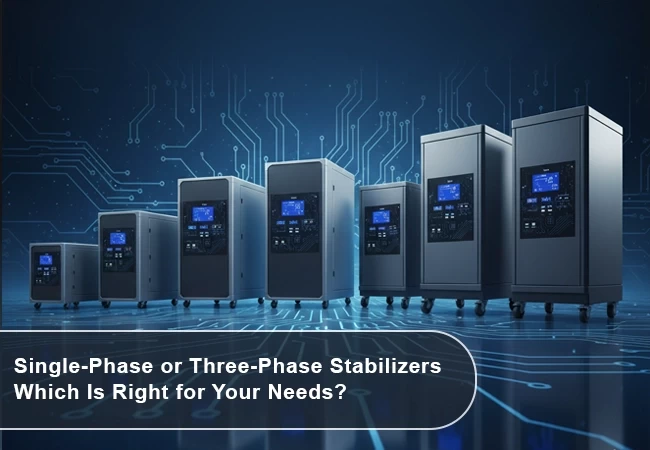
Look around, and we can understand that today’s fast-paced world that we live in depends on electricity to power everything. Be it homes, offices, industry, or medical facilities, electricity is a very crucial requirement everywhere. But one of the biggest challenges we face in relation to power is dealing with fluctuating voltage. Even small variations in voltage can damage sensitive equipment, reduce efficiency, or shorten the lifespan of appliances. And among the options available, the most common choices are single-phase stabilizers and three phase voltage stabilizers. Even though both serve the same primary purpose of regulating voltage, it is important to note that their applications and suitability can vary depending on various needs.
What is a Voltage Stabilizer?
A voltage stabilizer is an electrical device that maintains a stable output voltage despite fluctuations in the input supply. It protects electrical equipment from issues caused by high or low voltage, such as overheating, breakdowns, or reduced performance. Stabilizers are especially important for industries, commercial spaces, and even households where a stable power supply is critical.
Single-Phase Stabilizers
Single-phase stabilizers are designed for systems that use a single-phase power connection. Most homes, small offices, and light commercial setups mainly use single-phase connections, which makes these stabilizers ideal for them.
Benefits of Single-Phase Stabilizers
- Provide reliable voltage regulation for smaller loads
- Compact design and easy to install
- Cost-effective for residential and small-scale commercial use
- Wide capacity range, usually from 1KVA to 30KVA, depending on the type
Applications of Single-Phase Stabilizers
Single-phase stabilizers are commonly used for home appliances like refrigerators, air conditioners, televisions, petrol pumps, medical equipment in small clinics, textile machines, and colour labs in smaller setups.
Three Phase Voltage Stabilizer
A three-phase voltage stabilizer is designed for larger systems that use three-phase power connections. These are commonly found in industrial facilities, hospitals, large offices, and commercial establishments. Since three-phase connections handle higher loads, the stabilizers built for them are more powerful and versatile.
Benefits of Three Phase Voltage Stabilizers
- Protect large and sensitive equipment from voltage fluctuations
- Handle higher loads compared to single-phase stabilizers
- Often equipped with advanced features such as single-phasing preventers, surge suppression, and output protection
- Available in both air-cooled and oil-cooled models to suit different requirements
Applications of Three Phase Voltage Stabilizers
These three phase voltage stabilizers are widely used in medical equipment in hospitals, lifts and elevators, food processing units, industrial machines and process control units, as well as textile factories and hospitality facilities.
The capacity of three phase voltage stabilizers can range from 3KVA to as high as 2500KVA, making them suitable for everything from medium-sized businesses to large-scale industries.
Difference Between Air-Cooled & Oil-Cooled Stabilizers
You might already know that stabilizers are also available in air-cooled as well as oil-cooled designs.
Air-Cooled Stabilizers are compact, efficient, and suitable for small to medium loads. They are often used in residential and small commercial applications. Capacities mainly range from 1KVA to 20 KVA for single-phase and 3KVA to 60KVA for three-phase.
Oil-Cooled Stabilizers are designed for heavy-duty applications where higher loads are involved. They are more durable and can handle extreme conditions. This makes them ideal for industries. Their capacity can go up to 2500 KVA.
Both types include advanced features like high/low voltage output protection, single-phasing preventers, surge suppression, and filters for noise-free output. They also ensure no waveform distortion and are free from harmonics. This guarantees smooth operation of the equipment.
Single-Phase vs. Three-Phase Stabilizers
|
Feature |
Single-Phase Stabilizer |
Three-Phase Stabilizer |
|
Power Supply Type |
Works with single-phase supply (one live wire + neutral), which is for homes and small offices. |
Works with three live phases (L1, L2, L3) + neutral. Mostly used for industries, large commercial units. |
| Voltage Rating & Capacity | Usually supports lower power capacities (up to a few kVA) suited for small loads. | Higher capacity; can handle much larger kVA loads. Often designed for industrial or heavy-duty equipment. |
| Load Handling or Distribution | Best when the load is light or limited to a few appliances. Less complex and only needs to stabilize one line. | Better for balancing loads over three phases. More uniform current flow, less strain on individual lines. |
| Cost | Lower initial cost. Cheaper installation and maintenance. | Higher cost. More complex installation, maintenance, and they are more expensive hardware. |
| Physical Size and Weight | Smaller, lighter, and easier to install in tight or domestic spaces. | Larger, bulkier units need more space and are heavier. |
|
Complexity & Control |
Simpler control mechanisms. Possibly relay or basic servo/automatic regulation for one phase. |
More complex controls. Need to monitor and regulate all three phases and keep phase balance. Often uses more advanced servo or thyristor controls. |
|
Efficiency & Energy Losses |
These are considered more efficient for small/simple loads. Less energy is wasted if the load matches the capacity. |
If the load is well balanced, the three-phase stabilizer is efficient. But if heavily underloaded or phases are unbalanced, losses can increase. |
|
Suitability / Use Case |
Households, small shops, clinics, and small offices. Appliances like TVs, refrigerators, and lights. |
Factories, hospitals, large offices, industrial machines, compressors, heavy motors, and HVAC systems with high power demand. |
|
Cooling or Environmental Considerations |
It may come in smaller, air-cooled models since the load is smaller. Less demanding cooling needs. |
Often need better cooling (air or oil cooled, depending on size). Industrial environments may require oil-cooled or larger heat dissipation arrangements. |
Why Choose Supra for Stabilizers?
As one of the best servo-controlled voltage stabilizer manufacturers, Supra supplies top-notch servo voltage stabilizers. Our stabilizers are designed with cutting-edge technology and deliver consistent results across different applications. If you choose single-phase or three-phase models, Supra ensures protection, efficiency, and durability.
Our stabilizers are trusted by industries like healthcare, food processing, textiles, hospitality, and many more. With a wide capacity range and the option for custom-made solutions, Supra meets the unique needs of every customer.
Conclusion
Voltage stabilizers are essential for protecting modern equipment, and choosing between a single-phase stabilizer and a three-phase voltage stabilizer comes down to your power requirements, application, as well as setup. Both types of stabilizers are highly effective when chosen correctly for the load they need to support.
For more information about servo stabilizers, please get in touch with Supra Hi-tech.