Power outages are a common reality across India, and the demand for reliable backup power has never been higher. Inverters have become an essential part of homes, offices, and industries alike, and the battery powering those inverters makes all the difference. For decades, backup power systems relied on lead-acid batteries because they were familiar and widely available. However, their limitations, such as high weight, gas emissions, and sensitivity to operating conditions, make them less suitable for modern, high-demand applications. Today, lithium-ion technology is the benchmark for systems where reliability, efficiency, and long service life are critical.
A common issue in the industry is treating lithium-ion as a single, uniform category. In reality, there are multiple variants, and the internal material configuration of each cell is what determines how it performs in an inverter system. That distinction directly affects whether a system delivers consistent performance over many years or requires frequent replacement and maintenance.
What is a Lithium-Ion Battery for an Inverter?
A lithium-ion (Li-ion) battery for an inverter is a rechargeable energy storage unit that supplies power to the inverter when grid electricity is unavailable. Lithium-ion batteries are built on a chemistry where lithium ions move between an anode and a cathode during charging and discharging. The materials used, such as iron phosphate, manganese, or nickel-cobalt blends, determine important performance features like energy density, safety, lifespan, and discharge ability. In high-capacity backup systems, these batteries are integrated to balance energy density (the amount of energy stored) and specific power (the speed of energy delivery). This requires careful management of thermal stability, charge cycles, and discharge rates. This results in a system capable of delivering high current on demand while maintaining consistent long-term performance.
Also read: How Inverters Impact Your Electricity Bill: Will It Save or Increase Your Electricity Bills?
Types of Lithium-Ion Batteries
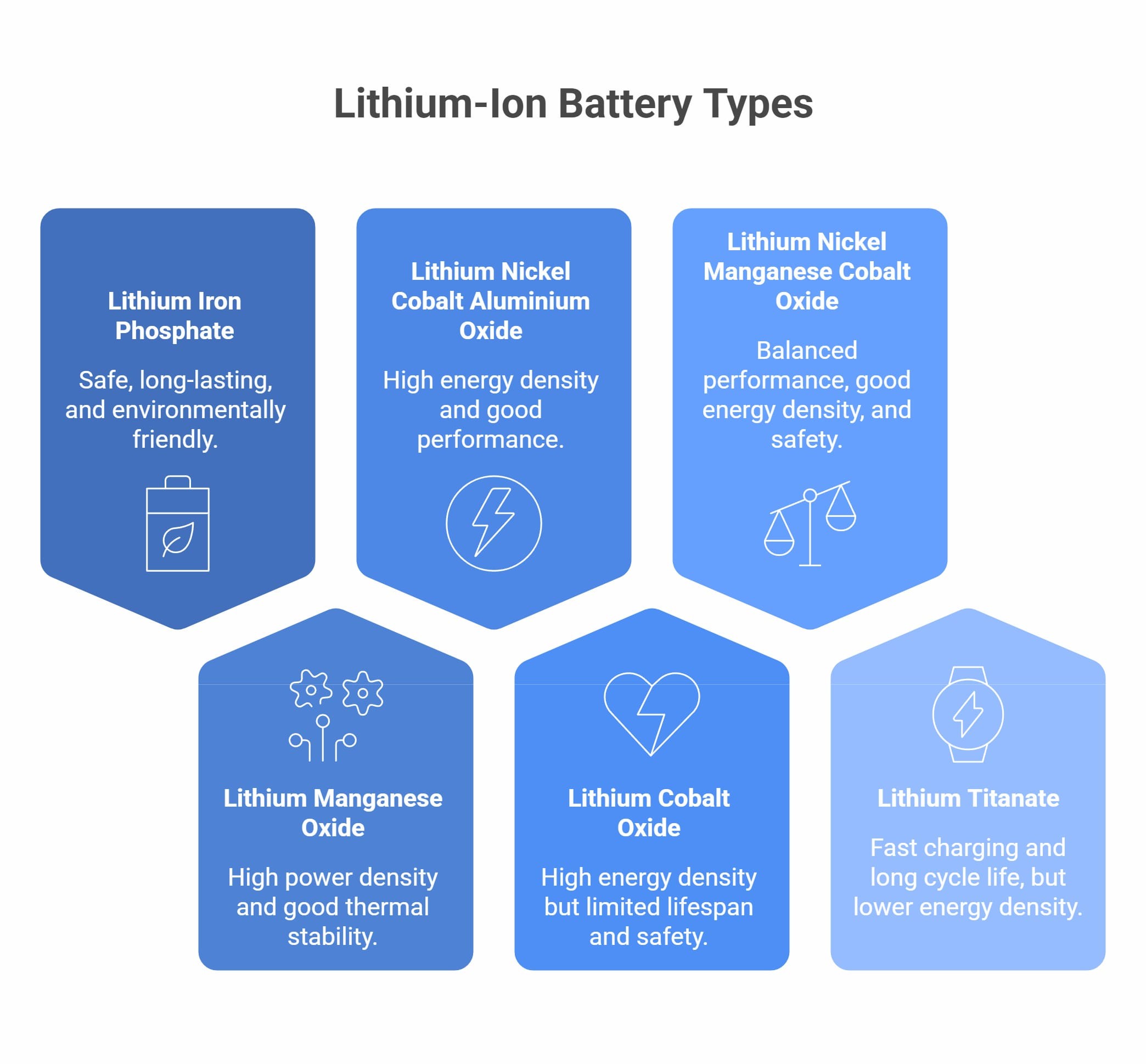
To understand the current marketplace, it is essential to be familiar with the six main lithium-ion chemistries. They each have a specific role to play in today’s energy landscape. Their differences dictate battery behavior over a range of loads, temperatures, and cycles. A clear understanding of each type is essential for selecting the right solution for specific power requirements.
1. Lithium Iron Phosphate (LiFePO4 / LFP)
LFP is widely used in advanced backup systems due to its strong structural stability and long operational life. The technical superiority comes from a phosphate-based cathode with a strong olivine crystal structure. This creates a chemical bond that is virtually impossible to break under standard electrical or thermal stress. For the end-user, this means high safety, as LFP is inherently resistant to thermal runaway and won't release oxygen during a fault. With cycle life often exceeding 5,000 charge cycles, it is the most durable energy storage solution for inverters available today.
2. Lithium Manganese Oxide (LiMn2O4 / LMO)
LMO is the industry’s high-power output specialist. It has a three-dimensional spinel structure that functions like a multi-lane pathway. This allows ions to move with minimal resistance. As a result, LMO is suitable for high-demand environments, such as surgical clinics or Tier-3 data centers. In these settings, the inverter must manage a large, sudden load without a drop in voltage. Although it has a slightly shorter cycle life than LFP, its capability to handle sudden thermal spikes makes it vital for mission-critical hardware.
3. Lithium Nickel Cobalt Aluminium Oxide (NCA)
NCA is known for its high energy density performance. It delivers more watt-hours per kilogram than almost any other commercial blend, which is why it’s the standard for premium, long-range electric vehicles. In professional inverter and backup power systems, NCA is a specialist solution for space-constrained environments like high-rise telecom hubs. Because it is sensitive to temperature, NCA requires a sophisticated, precision-engineered Battery Management System (BMS) to stay within its operational range, ensuring stable and safe operation under defined conditions.
4. Lithium Cobalt Oxide (LiCoO2 / LCO)
LCO is the legacy chemistry that started the portable electronics revolution. However, by 2026, it is largely considered obsolete for large-scale backup. While the energy density is high, it lacks the thermal stability and ruggedness needed for the heavy, deep-discharge cycles of an industrial inverter. However, we actively advise against LCO for large-scale storage. Its cycle life just doesn't provide the Total Cost of Ownership (TCO) that a professional-grade system demands.
5. Lithium Nickel Manganese Cobalt Oxide (NMC)
NMC is the industry’s balanced-performance solution. It’s a hybrid approach that balances nickel’s energy with manganese’s stability. Many modern wall-mounted power systems use NMC due to its compact design and balanced performance. One key advantage we highlight for our clients in northern regions is its superior cold-weather performance because it maintains a much higher charging efficiency in sub-zero temperatures, making it a reliable choice for winter reliability.
6. Lithium Titanate (LTO)
If LFP is a high-durability solution, LTO is a heavy-duty system. By replacing the traditional graphite anode with titanate nanocrystals, this design achieves a surface area that allows for ultra-fast charging, a full 0-to-100% recharge in roughly ten minutes. It is also extremely long-lasting, often rated for 20,000+ discharges. While the upfront cost is higher, for critical industrial infrastructure where downtime costs millions, LTO is a highly reliable choice. It’s a long-term solution that can outlast the machines it supports.
Why is Lithium Used in Batteries?
Lithium is the lightest metal on the periodic table and has the highest electrochemical potential of any element, meaning it can store and release more energy per unit of weight than almost any other material. This makes it uniquely suited for high-performance, rechargeable batteries.
Beyond energy density, lithium-ion batteries have no memory effect (unlike older nickel-cadmium batteries), so they do not need to be fully discharged before recharging. They also self-discharge at a much lower rate, retaining their charge for longer when not in use. When combined with a good battery management system, lithium-ion batteries offer safe, efficient, and long-lasting power storage, making them the ideal backbone for modern inverter solutions.
How to Choose the Right Lithium-Ion Battery for Your Inverter
Selecting the right lithium-ion battery for your inverter depends on several factors.
- Application Type: For home and small office inverters, LFP (Lithium Iron Phosphate) is the safest and most cost-effective choice. For industrial or high-power commercial setups, NMC or NCA may be better suited.
- Cycle Life Requirement: If you expect heavy, daily use, prioritise batteries with high cycle ratings. LFP and LTO are the leaders in this category.
- Safety: If safety is your primary concern, especially in enclosed spaces or near flammable materials, LFP is the most suitable option.
- Budget: While all lithium-ion batteries are pricier upfront than lead-acid, LFP offers the best value over time due to its long lifespan. NCA and NMC cost more initially but may be justified for performance-intensive applications.
- Temperature Conditions: If the battery will be used in extreme cold, LTO handles low temperatures better than other types. For hot environments, LFP also performs well.
- Charging Speed: If fast turnaround is essential, LTO offers the fastest charging times, though at the cost of energy density.
Always ensure your inverter is compatible with the specific battery chemistry you choose, and look for batteries that include a certified Battery Management System (BMS) for safety and performance monitoring.
The Smart Choice for Long-Lasting Power Backup
Lithium-ion batteries have transformed the way inverter systems operate by offering reliable, efficient, and long-lasting power backup solutions. With various types available, each designed to meet different performance and safety requirements, users have the flexibility to choose the most suitable option for their needs.
Supra Hi-Tech is a leading manufacturer and provider of advanced power control and backup solutions, trusted for decades in industries, businesses, and homes. We specializes in designing and producing high-quality power products, including online UPS systems, line-interactive UPS, servo stabilizers, inverters, solar solutions, and related power accessories.