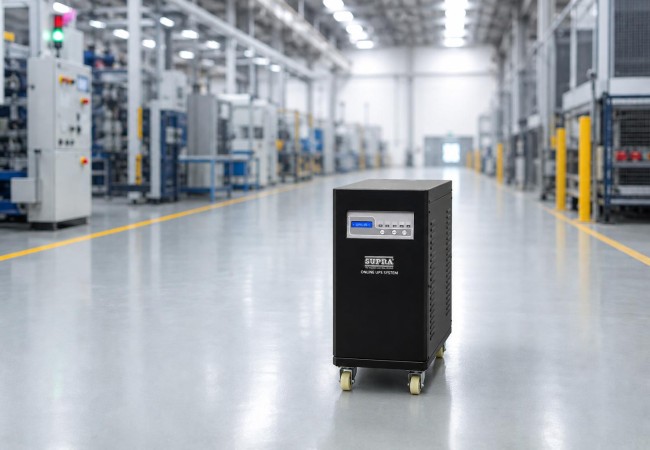
A power cut in a manufacturing plant is rarely just a matter of switching the lights back on. When a production line stops unexpectedly, operators may have to reset machines, check unfinished products, restart control systems, and sometimes discard materials that can no longer be used. Even a short interruption can therefore turn into a much longer production delay.
This is one reason many factories use an online UPS system for critical equipment. It provides continuous power to sensitive electrical and electronic systems and helps the plant deal with both power cuts and fluctuations in the incoming supply.
For manufacturing facilities that rely heavily on automation, computer-controlled machinery and electronic controls, having dependable backup power can be an important part of keeping production on schedule.
Why a Short Power Failure Can Cause a Long Delay
Manufacturing processes are often interconnected. One machine may feed material to another, while sensors and control systems monitor the entire operation. If power is lost at one point, the effect can spread through the production line.
Consider a CNC machine working on a batch of components. If the power suddenly goes off halfway through the process, the operator may need to inspect the machine and workpiece before production can continue. In some cases, the component may have to be rejected altogether.
The same problem can occur in packaging, food processing, pharmaceutical manufacturing, printing and other industries where production follows a defined sequence.
The duration of the power cut is not always the most important factor. What matters is what the equipment is doing when the interruption occurs.
How an Online UPS Helps
An online UPS works differently from a basic standby backup system. With an online UPS, the connected equipment receives power through the UPS continuously. The system converts incoming AC power to DC and then converts it back into regulated AC power.
When the utility supply fails, the UPS battery takes over without the type of transfer delay associated with conventional standby systems.
That continuous supply is particularly useful for equipment that cannot tolerate even a brief interruption. It also helps separate sensitive loads from several common power-quality problems.
For a factory, this means the UPS is doing more than providing battery backup. It is also helping maintain a cleaner and more stable power supply.
Protecting Automation and Control Systems
Today's manufacturing plants often depend on PLCs, industrial computers, sensors, control panels, and other electronic systems to keep machinery operating correctly.
These components may not consume as much power as a large motor or industrial machine, but they can be critical to the production process.
If a PLC or control computer suddenly shuts down, the machinery connected to it may stop as well. Restarting the system may require operator intervention, and in some cases the original operating sequence may not be restored automatically.
An online UPS can keep these control systems running through short interruptions and provide enough backup time for a controlled shutdown when an outage lasts longer.
Power Quality Matters Too
Power problems in a factory are not limited to complete blackouts.
Large motors, welding equipment, compressors, and other industrial loads can contribute to voltage fluctuations and electrical disturbances. Plants may also experience voltage sags, surges, or other variations in supply quality.
Sensitive electronic equipment can be affected by repeated disturbances even when the plant does not experience a complete power failure.
This is another area where an online UPS can be useful. Because of its double-conversion design, it continuously processes the incoming electricity before supplying it to the connected load. The result is a more stable supply for sensitive equipment.
Which Equipment Should Be Connected to a UPS?
It is not always practical or necessary to put an entire factory on UPS backup. Large motors, heaters, and heavy machinery may require far more power than the UPS system needs to provide.
Instead, manufacturers generally identify the equipment that is most important to production continuity.
Depending on the facility, this could include:
- PLCs and automation controllers
- CNC control systems
- Industrial computers
- Servers and networking equipment
- Instrumentation and monitoring systems
- Process control equipment
- Communication systems
- Security and access-control systems
For example, a plant may allow non-critical machinery to stop during an extended outage while keeping the control room, production monitoring system, and essential automation equipment running.
This approach can make the power backup system more practical and cost-effective.
UPS and Generator: Why Plants May Need Both
A UPS and a generator serve different purposes, so they can work well together.
A generator is designed to provide power for a longer period, but it normally needs some time to start and stabilize after a mains failure. An online UPS can cover that gap immediately.
Once the generator is ready, the UPS can continue supplying the connected equipment using the generator's output. If the generator later shuts down or the utility supply is restored, the UPS continues to manage the transition.
This arrangement is particularly useful in plants where a sudden loss of power could interrupt a critical process.
Learn more: Uninterrupted Power Supply Benefits: Why You Should Consider a UPS System
Choosing an Online UPS for a Manufacturing Facility
There is no single UPS capacity that suits every factory. The right choice depends on the equipment being protected and how the plant operates.
Before purchasing a system, it is worth looking at the actual connected load, the equipment's sensitivity to interruptions, the required backup time, and whether the UPS will work alongside an existing generator.
Future expansion should also be considered. A plant that expects to add machinery or increase its automation systems may need additional UPS capacity later.
Battery type and maintenance requirements deserve attention as well. The battery is a key part of the backup system, so its expected service life, charging requirements, operating conditions and replacement plan should be considered during selection.
The Cost of Downtime Should Be Part of the Calculation
The price of a UPS is easy to calculate. The cost of an unexpected production stoppage is often harder to see.
A power failure can affect labor utilization, production schedules, raw materials, machine operation, and delivery commitments at the same time. For some manufacturers, a few minutes of downtime can be considerably more expensive than the power protection system installed to prevent it.
This does not mean every machine needs a dedicated UPS. It means manufacturers should identify where an interruption would have the greatest operational impact and protect those points first.
Read more: Essential Checklist Before Buying an Online UPS System
Conclusion
Reliable power is an important part of modern manufacturing. As factories become more automated and dependent on electronic controls, even a short electrical interruption can affect an entire production process.
An online UPS provides continuous, regulated power to critical equipment and can help protect automation systems, industrial computers, and other sensitive loads from interruptions and power-quality problems. When combined with a generator and a suitable maintenance plan, it can form an effective part of a plant's overall power continuity strategy.
Supra Hi-Tech is a leading manufacturer and provider of advanced power control and backup solutions, trusted for decades by industries and businesses. The company specializes in online UPS systems, line-interactive UPS, servo stabilizers, inverters, solar solutions, and related power accessories.