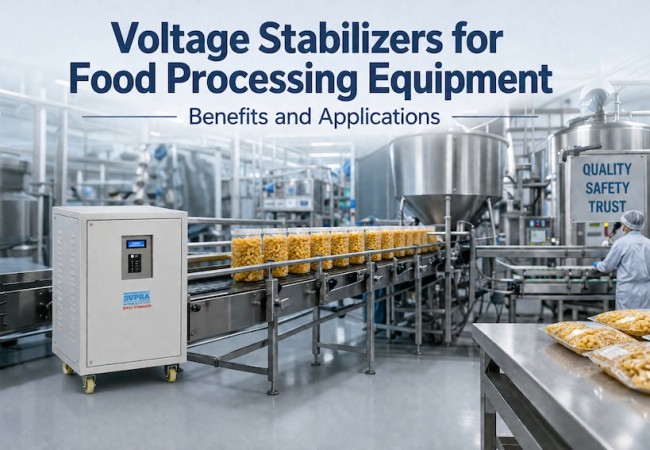
Food processing plants run on tight production windows and even tighter margins. A single voltage sag during a milling shift or a compressor trip in a cold store can cost a full day's output, and in some cases the raw material along with it. Most of India's food processing capacity sits in regions where the electricity grid is shared with heavy agricultural load, which means voltage swings are not an occasional problem but a routine one. A voltage stabilizer is the equipment that keeps this instability from reaching motors, PLCs, and refrigeration systems in the first place.
Why Food Processing Equipment is Vulnerable to Voltage Fluctuation
Food processing lines combine two kinds of load that both react badly to unstable voltage. On one side are high-torque motors: flour mill rollers, mixers, conveyors, and refrigeration compressors, all of which draw several times their rated current at startup and stall or overheat if voltage sags at the wrong moment. On the other side are servo-driven packaging and filling machines running on PLCs, which are sensitive to even small dips and can fault out mid-cycle, leading to underfilled packs or seal failures.
In states where flour mills, rice shellers, and cold stores sit close to agricultural feeders, the problem gets worse during harvest season, when irrigation pumps and crop processing equipment draw on the same lines at the same time. This is exactly when food plants are running at peak capacity, so the timing works against them.
Common Voltage Problems Food Processors Face
- Undervoltage during peak hours: Grid voltage frequently falls below the safe operating band for motors, especially during peak agricultural and industrial demand.
- High inrush current at motor startup: Compressor and motor startups draw four to six times rated current; if supply voltage is already low, the motor cannot reach full speed and trips repeatedly, wearing down windings and bearings.
- Sudden voltage sags and surges: Voltage sags of even a few percent can cause PLC resets on servo-driven packaging and filling lines, leading to stoppages and wasted product.
- Unbalanced and unpredictable supply: Feeders shared with agricultural or industrial neighbours introduce voltage swings that a plant's own load management cannot control.
Equipment at Highest Risk from Voltage Instability
Not every machine on a food processing floor is equally exposed. The equipment most affected includes:
- Packaging and filling machines: Servo motors and PLCs stop or misfire on small voltage dips, risking overfill, underfill, or line stoppage.
- Cold storage compressors: These are the single highest-risk item in any cold chain; repeated undervoltage trips shorten compressor life and threaten product temperature control.
- Flour mill and rice mill motors: Direct-on-line motors depend entirely on grid voltage for startup torque; low voltage causes stalling and premature winding failure.
- Industrial mixers and kneaders: Voltage variation changes motor torque, which affects mixing consistency and, over time, batch-to-batch product quality.
- FMCG production and sealing lines: These lines combine servo drives, sensors, and control electronics, all of which are sensitive to unstable supply.
Key Benefits of Voltage Stabilizers in Food Processing
- Equipment protection: A stabilizer holds output voltage within a tight band regardless of input fluctuation, protecting motor windings, compressor coils, and control electronics from long-term damage.
- Lower energy consumption: Compressors, mixers, and mill motors run at their intended speed and torque instead of drawing extra current to compensate for low voltage, which lowers energy bills over sustained operating hours.
- Reduced downtime: Fewer nuisance trips on packaging and filling lines mean fewer stoppages, less rework, and more predictable daily output.
- Better product and process consistency: Stable voltage keeps fill weights, seal quality, and process temperatures within specification, which matters directly for food safety compliance.
- Extended equipment life: Motors and compressors that are not repeatedly stressed by undervoltage starts last longer, cutting down on unplanned maintenance and early replacement.
- Cold chain reliability: A correctly sized stabilizer keeps cold storage compressors cycling normally even when grid voltage dips, which is the difference between a stable cold chain and a spoiled batch.
Learn more: Top 10 Benefits of Using Servo Voltage Stabilizer
Applications Across Food Processing Segments
Voltage stabilizers are used across nearly every stage of food processing, and the right unit depends on the load profile of the facility.
- Flour mills and rice shellers: Servo voltage stabilizers in the smaller KVA range are common here, protecting direct-on-line mill motors that would otherwise stall on low voltage.
- Cold storage and warehousing: Wide input range and fast response units are specified to prevent compressor trips during rapid voltage changes, which is critical for maintaining set temperatures.
- Packaging, filling, and sealing lines: Servo stabilizers here focus on protecting PLCs and servo drives from small, fast voltage dips that would otherwise stop the line.
- Bakeries and beverage plants: Bakeries and beverage units rely on stable voltage to keep mixers, ovens, and bottling lines running at consistent output.
- Large FMCG plants: Full production facilities typically combine several stabilizers sized for different sections, sometimes with a dedicated unit for cold storage so that maintenance on one line does not affect the other.
Choosing the Right Stabilizer
Sizing starts with adding up the connected load in kilowatts, adjusting for power factor, and building in a safety margin for motor startup surges rather than sizing to running load alone. Air-cooled servo stabilizers work well for smaller plants in ventilated indoor settings, while oil-cooled units are the better fit for larger loads, outdoor installations, or plants in regions with high ambient temperatures. For cold storage in particular, a wide input voltage range and a fast response time matter more than KVA rating alone, since the goal is to catch a voltage dip before it ever reaches the compressor.
Read more: How to Find the Right Servo Stabilizer Manufacturer and Supplier for Your Business Needs
Conclusion
Food processing facilities cannot rely on an unstable power supply. Protecting automated systems, preserving inventory, and maintaining consistent product quality require reliable, commercial-grade power conditioning equipment.
For facilities seeking dependable power protection, Supra Hi-Tech is a trusted manufacturer and supplier of advanced power conditioning and backup solutions. We design and manufacture high-performance online UPS systems, line-interactive UPS systems, servo voltage stabilizers, inverters, solar power solutions, and a wide range of power accessories to meet diverse industrial requirements.
Protect your production efficiency, reduce maintenance and energy costs, and ensure uninterrupted plant operations with reliable power solutions from Supra Hi-Tech.