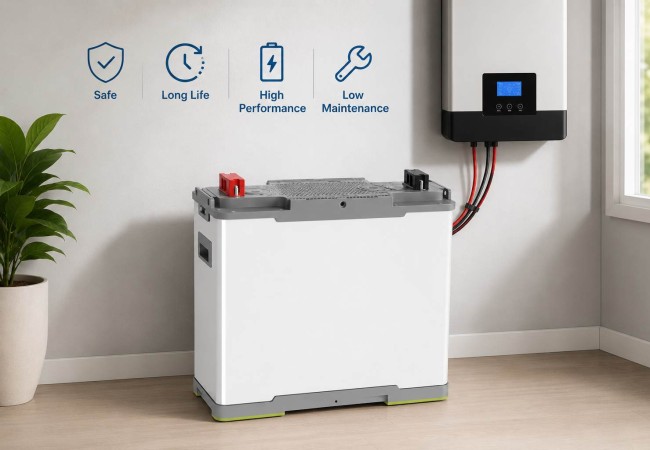
A lithium-ion inverter battery is a genuine upgrade over lead-acid: longer service life, faster recharge, and far less upkeep. However, the battery is only one part of the overall system. The upgrade delivers its full benefits only when the inverter, load requirements, installation space, and warranty conditions are compatible with the battery.
You don't need an engineering background to evaluate these factors; you simply need to know what to check before making a purchase.
1. Inverter Compatibility and Charging Configuration
This is the check most buyers skip, and it's the one that matters most. Most inverters are built around lead-acid charging profiles by default. Lithium-ion and LiFePO₄ batteries run on different voltage thresholds, absorption curves, and cut-off limits, so pairing one with an inverter still running a lead-acid profile can stress the BMS, cut into usable capacity, or void the warranty outright. It isn't about whether the cable fits. It's about whether the charging behaviour actually matches the battery.
Before you upgrade, check the following:
- Whether your inverter has a dedicated lithium or LiFePO₄ mode, or lets you configure the parameters manually
- Absorption and float voltage settings, which need to stay within the range your battery manufacturer specifies
- Low voltage cut-off threshold, aligned with the battery's minimum discharge limit
- Whether a firmware update from the manufacturer can unlock lithium-compatible settings
- Charging current output, which should stay within the battery's recommended charge rate
If your inverter can't be brought in line on these points, you're looking at a manufacturer-approved firmware update, an approved charging setup, or an inverter upgrade, depending on what your configuration allows.
2. System Voltage and Battery Bank Matching
Voltage mismatches are one of the most common reasons a lithium battery fails early. Your inverter runs at a fixed system voltage, usually 12V, 24V, or 48V, and your battery bank has to match it exactly. Get this wrong and you're not just losing performance, you're inviting protection faults and unpredictable inverter behaviour.
If you're building a multi-battery bank, how you configure it matters just as much as the voltage itself:
- Series wiring increases voltage, parallel wiring increases capacity. Check which one your inverter actually supports
- Not every lithium battery is rated for parallel operation. Check the datasheet rather than assuming
- Confirm each unit's BMS is rated for the combined current draw once multiple batteries are connected
- Use wires of the same length and gauge across the whole bank so current draw stays even
3. BMS Specifications and Protection Features
The battery management system, or BMS, is what keeps a lithium battery safe once it's actually in use. Left unprotected, lithium systems can be genuinely unsafe: overcharging, deep discharge, overheating, and short circuits are all real risks. A poorly specified BMS shows up as nuisance trips, reduced backup time, and a shorter lifespan overall.
When you're evaluating BMS quality, look for:
- Cell balancing support, where available, to keep individual cell voltages even across the pack
- Protection against overcharge, deep discharge, short circuits, and over-temperature conditions
- A continuous discharge current rating that covers your connected load, including motor startup surges
- Communication ports such as RS485 or CANbus, if your inverter supports smart battery communication
- Whether the BMS is replaceable or sealed into the unit, since a sealed BMS failure usually means replacing the whole battery
Ask the manufacturer for the actual BMS specification sheet, not just the general product brochure.
Read more: Thermal Runaway in Lithium Batteries Used in Inverters: Myths, Risks, and Safety Standards
4. Capacity Sizing Based on Your Actual Load
Sizing a battery off a rough guess instead of a real load calculation is a mistake we see constantly. Undersize it and you'll cycle the battery too deep, too often, which shortens its life no matter how good the chemistry is. Oversize it and you're paying for capacity you'll never use.
Work through these steps before you settle on a capacity:
- List every appliance you'll run during an outage and note its wattage
- Estimate your average daily outage duration based on your location and grid reliability
- Build in reasonable headroom, since discharging to the absolute limit on every cycle isn't good practice
- Work from usable capacity, based on the depth of discharge rating, not the total rated Ah
- Account for any appliances you plan to add soon, so you don't have to resize the system again later
A proper load audit before you finalise the spec saves years of frustration down the line.
5. Warranty Terms and Manufacturer Support
A lithium-ion battery is a long-term purchase, and the warranty behind it is only as good as the support that backs it up. Some warranties are voided outright if the battery is paired with an incompatible inverter. Others exclude damage from improper installation or from running the battery outside its specified temperature range.
Before you finalise the purchase, confirm:
- Whether the warranty stays valid with your specific inverter brand and model
- What's actually covered: full replacement, degradation below a set threshold, or component repair only
- How claims are processed, and what documentation you'll need to support one
- Whether the manufacturer has a service presence in your region
- Any installation requirements in the warranty terms, since some manufacturers require professional installation to keep the warranty valid
A product is only as reliable as the support standing behind it.
Learn more: Lead-Acid vs. Lithium-Ion Batteries: Which is More Efficient for Inverters?
Choosing the Right Lithium Battery Upgrade for Reliable Power Backup
For most businesses that depend on steady backup power, moving to a lithium-ion inverter battery makes sense. The benefits are real, and the economics work out over time. What protects that investment is the work you put in before the battery ever arrives.
We put this checklist together because overlooking these steps can lead to compatibility issues, incorrectly sized batteries, reduced performance, and avoidable warranty disputes. Every point on this list is something we've run into in the field.
Supra Hi-Tech Electro Equipments Pvt. Ltd. is a manufacturer and provider of power control and backup solutions, serving industrial and commercial customers. We specialise in designing and manufacturing high-quality power products, including online UPS systems, line-interactive UPS systems, servo stabilisers, inverters, solar solutions, and related power accessories. Our team understands power conditions and backup requirements and can provide technical guidance to help you select a suitable solution.