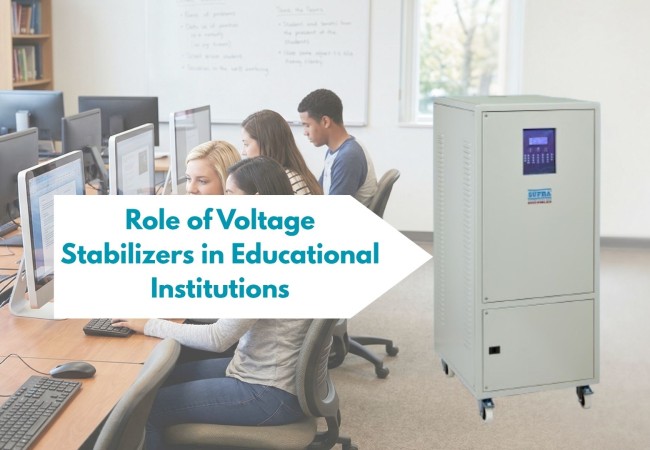
Every educational institution today runs on technology, from smart classrooms and computer labs to digital examination systems and high-speed internet networks. But voltage fluctuations, spikes, and surges can damage equipment, cause sudden shutdowns, and lead to expensive repairs. That’s why voltage stabilizers are important. They help maintain a steady power supply, protect sensitive devices, and keep day-to-day operations running smoothly.
A voltage stabilizer for educational institutions is no longer an optional accessory; it is a fundamental power management investment. A servo voltage stabilizer is one of the simplest, most cost-effective ways to protect everything a campus runs on. Here's why it matters more than most institutions realise.
Understanding Voltage Fluctuations and Their Impact on Educational Institutions
Voltage fluctuations happen when the supply voltage regularly rises or dips outside the standard 220–240V range. The causes are overloaded grids, sudden load changes on shared lines, poor utility infrastructure, or transformer faults. In semi-urban and rural areas, this is an everyday problem.
For educational institutions, the consequences range from annoying to expensive. A voltage surge in a computer lab can instantly corrupt hard drives or destroy motherboards. A prolonged voltage dip forces motors in AC units and water pumps to draw excess current, which overheats them and shortens their life significantly. Persistent low-voltage conditions known as brownouts cause motors in air conditioning systems and water pumps to draw excess current, leading to overheating and premature failure. Servers managing student records or online examinations may crash mid-session, resulting in data loss, disrupted assessments, and administrative chaos.
Why Stable Power Supply is Essential for Educational Institutions
Modern educational institutions use a lot of different digital tools and technologies to give students a quality education. Smart boards, projectors, computers, and online learning platforms are all important parts of the teaching process. These systems need a steady power supply to work without interruption.
Unreliable power can disrupt lectures, delay online examinations, and interrupt virtual classrooms. Administrative tasks such as attendance management, data processing, and communication systems also depend on consistent electricity. In higher education institutions, research activities and advanced laboratory work require uninterrupted power to maintain accuracy and continuity.
A stable voltage supply not only supports academic excellence but also enhances the overall efficiency of institutional operations.
What Is a Voltage Stabilizer and How Does It Function?
A voltage stabilizer continuously monitors incoming supply and corrects it to a safe, steady output. If the voltage climbs too high, it brings it down. If it drops too low, it boosts it back up.
Servo voltage stabilizers are widely considered one of the most reliable options for institutional use. They work with a servo motor–driven autotransformer to adjust voltage smoothly and continuously in real time, unlike older relay-type stabilizers that make sudden corrections and can create minor surges.
A good servo stabilizer can typically handle input voltage ranging from 130V to 270V while maintaining output within about ±1% accuracy. They are available in both single-phase and three-phase models, with capacities ranging from a few kVA for small labs to large systems capable of supporting an entire campus.
Read more: What Does a Stabilizer Do? Types and Their Unique Functions
Key Equipment in Educational Institutions That Require Voltage Protection
Educational institutions use a variety of electrical and electronic equipment that are highly sensitive to voltage changes. Protecting these assets is crucial for maintaining smooth operations. Some of the key equipment that require voltage protection includes:
- Computer labs and servers: hard drives and processors are easily damaged by even brief voltage spikes.
- Smart classrooms: projectors, flat panels, and AV systems degrade faster on fluctuating power.
- Science and research labs: precision instruments need stable voltage to give accurate readings.
- Exam and admin systems: any data loss here has serious academic and legal consequences.
- CCTV and security: surveillance systems need uninterrupted power to stay functional.
- Air conditioning: HVAC compressors are particularly sensitive to voltage dips and brownouts.
How Voltage Stabilizers Protect Sensitive Educational Infrastructure
Beyond basic voltage correction, modern servo stabilizers come with built-in protections that guard against a wider range of electrical faults: over-voltage cutoff, under-voltage cutoff, single-phasing prevention, short-circuit protection, and thermal overload protection. Together, these create a reliable safety net around the campus's entire electrical setup.
During a surge from lightning, load shedding recovery, or grid switching, the stabilizer limits the output to a safe level before it reaches any equipment. During a brownout, it boosts the voltage so motors and servers don't strain. The result is that equipment runs within its designed operating range consistently, which directly translates into fewer breakdowns and longer service life.
Benefits of Installing Voltage Stabilizers in Educational Institutions
Installing voltage stabilizers offers numerous advantages for educational institutions, making them a valuable investment.
- Longer equipment life: devices running on stable voltage last significantly longer.
- Lower maintenance costs: fewer problems mean less money spent on repairs and replacements.
- No disruptions during exams or classes: stable power keeps everything running when it matters most.
- Better energy efficiency: equipment at the right voltage draws only what it needs, reducing electricity bills.
- Data protection: servers and exam systems face far less risk of corruption or loss.
- Reduced fire and safety risks: voltage irregularities are a common cause of overheating and electrical fires.
Choosing the Right Voltage Stabilizer for Educational Institutions
Selecting the right voltage stabilizer is essential to maximize protection and efficiency. Educational institutions should consider several factors before making a decision.
- Load Capacity: Ensure the stabilizer can handle the total electrical load of the institution.
- Voltage Range: Choose a stabilizer suitable for the local voltage fluctuation range.
- Type of Stabilizer: Servo stabilizers are ideal for large-scale applications due to their accuracy and reliability.
- Installation Requirements: Decide between centralized systems or individual stabilizers for specific equipment.
- Quality and Support: Opt for trusted manufacturers that offer durable products and reliable after-sales service.
A well-chosen stabilizer can provide long-term benefits and ensure uninterrupted educational activities.
Learn More: How to Find the Right Servo Stabilizer Manufacturer and Supplier for Your Business Needs
Ensuring Reliable Power for Educational Institutions with the Right Stabilizer Solution
Educational institutions carry a profound responsibility: to provide students with an environment where learning can happen without interruption. In today's digitally dependent campuses, fulfilling that responsibility requires more than quality teachers and modern facilities. It demands a reliable, stable power supply that protects every piece of technology the institution depends on.
Servo voltage stabilizers are a practical and cost-effective investment for educational institutions. They help extend the life of equipment, protect important data, reduce maintenance issues, improve energy efficiency, and most importantly, prevent power-related problems from affecting the learning process.
For educational institutions seeking dependable and high-quality stabilizer solutions, Supra Hi-Tech offers industry-leading products designed for performance and durability. With decades of experience, we provide a wide range of power solutions, including servo stabilizers, online UPS systems, inverters, and solar products.