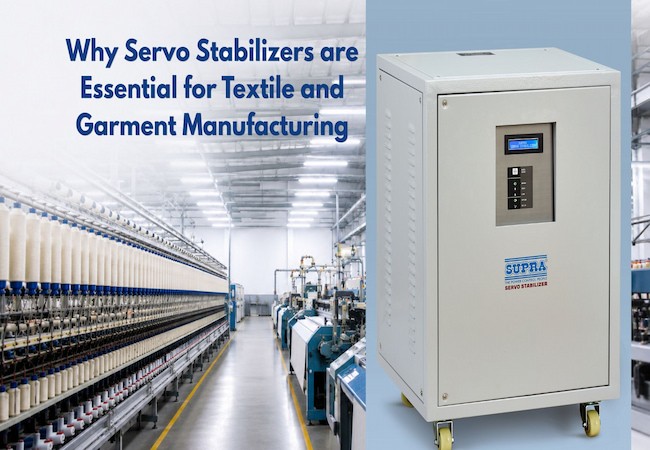
The textile and garment manufacturing industry is highly dependent on electrically powered machinery that operates around the clock. It involves processes that include spinning, weaving, knitting, dyeing, embroidery, printing, and stitching. Even a minor voltage fluctuation can interrupt production, affect fabric quality and damage sensitive components. But how does an industry that relies on uninterrupted performance maintain quality when fluctuations threaten every stage of manufacturing?
In an industry where speed and consistency largely determine profits, a stable power supply is the top priority. But what technology do textile manufacturers use to maintain voltage stability across such demanding production environments? The answer is servo stabilizers. In this blog we are going to learn the reason why servo stabilizers are a must in the textile and garment-making industry.
How Servo Stabilizers Correct Voltage Fluctuations in Real Time
A servo stabilizer continuously monitors the voltage coming in from the grid and corrects it in real time before it reaches your machines. The correction is smooth and stepless, unlike older relay-type stabilizers that jump between fixed voltage levels.
The mechanism works through a servo motor connected to a variable auto-transformer. A sensing circuit checks the output voltage several times per second. The moment it detects a deviation, it signals the servo motor to adjust the transformer tap, bringing the output back to the correct voltage level. The whole correction typically happens within one to two seconds, fast enough that most machines never notice the fluctuation on the grid side.
For a textile factory, this means every spindle, loom, dyeing vessel, and stitching unit gets the exact voltage it needs, regardless of what the grid is doing at that moment.
Learn more: How to Find the Right Servo Stabilizer Manufacturer and Supplier for Your Business Needs
Why Voltage Stability Matters at Every Stage of Production
Modern textile manufacturing involves multiple interconnected production stages, each dependent on specialised machinery operating with high precision. Spinning machines, knitting machines, looms, dyeing systems, compressors, embroidery machines, and automated garment production lines are all sensitive to voltage variations.
When voltage fluctuates frequently, the effects ripple across the entire operation. Motors and drives overheat, triggering unexpected shutdowns. Control panels and PLC systems risk damage. Beyond the machinery itself, instability leads to defective fabric, increased material waste, and production delays that are difficult to recover from.
In an industry where production timelines are fixed and orders are binding, unplanned downtime translates directly into financial loss. Servo stabilizers provide the electrical reliability needed to keep operations running without interruption.
1. Protection for Expensive Textile Machinery
Contemporary textile manufacturing units have large investments in sophisticated machinery such as weaving machines, dyeing units, embroidery systems and automated garment manufacturing machinery.
With frequent changes in voltage, there is bound to be some extra pressure on the motor, electrical circuitry, and the controller. In the long run, the changes in voltage might lead to breakdowns, production delays, higher maintenance bills, as well as possible equipment damage.
Servo stabilizers help prevent these problems by maintaining consistent voltage levels before power reaches the machinery. They continuously correct voltage fluctuations in real time, helping machines operate smoothly and safely throughout the production process. This protects expensive equipment and supports reliable performance, reduced downtime, and longer machine life.
2. Reduction in Downtime and Production Losses
In textile and garment manufacturing, an issue as simple as the power going out can have a significant impact throughout the production process chain. A loss or increase in voltage can cause the manufacturing machinery to shut down during any stage of the process such as weaving, dyeing, stitching, and printing.
However, restarting a machine after its operation may be challenging in many cases. Many machines need calibration and process adjustment before resuming regular operations. Additionally, processes such as dyeing and spinning are particularly vulnerable, as sudden power failures may lead to damage of raw materials.
Servo stabilizers prevent such problems for industries by ensuring that there is a constant supply of voltage during production processes. The use of a stable power source to power the machines makes the production process smoother since there are fewer disturbances.
3. Energy Efficiency and Operational Savings
Voltage fluctuations do more than interrupt production. They also force textile machinery to work under unstable electrical conditions, which can increase power consumption over time. When motors and industrial equipment are exposed to fluctuating voltage, they frequently draw excessive current in order to function properly. This can lead to overheating, unnecessary energy usage, and additional stress on machine components.
Servo stabilizers provide stable voltage to all equipment, helping to create an environment where all electrical devices can be used together efficiently. Equipment that operates at its correct voltages operates better, consumes the electricity more efficiently and produces less electrical stress or strain during operation.
Over time, these benefits can make a noticeable difference for textile manufacturers. Factories may experience lower electricity expenses, fewer machine breakdowns, reduced maintenance requirements, and a longer operational life for expensive equipment. In large textile facilities where multiple machines operate continuously throughout the day, these improvements can contribute to significant long-term cost savings while supporting more stable and reliable production.
What to Look for When Choosing a Servo Stabilizer for a Textile Plant
Choosing the right servo stabilizer for a textile plant involves evaluating factors such as accurate load capacity, input voltage correction range, enclosure protection for harsh factory environments, and whether a distributed or centralised setup best suits the production facility.
Capacity sizing: The stabilizer must be rated for the actual load the plant runs, not just the theoretical connected load. Begin by auditing every machine, noting its rated KVA or KW, applying a realistic diversity factor based on how many machines run simultaneously, and adding headroom for future expansion.
Input voltage range: Plants in areas with weak grid infrastructure need stabilizers capable of handling wide fluctuations, sometimes as much as plus or minus 50% of rated voltage. Plants on stronger feeders may require only plus or minus 20% correction range.
Enclosure rating: This matters significantly in a textile environment. Mills are typically dusty and humid, making a stabilizer with at least IP21 protection and heat-resistant insulation a practical necessity, not an optional upgrade.
Distributed versus centralised setup: For large factories, individual stabilizers for each production line are preferable to a single central unit. If one unit requires servicing, the rest of the plant continues running uninterrupted. Most quality servo stabilizers include a bypass switch for exactly this purpose.
Also Read: Top 10 Benefits of Using Servo Voltage Stabilizer
Supra Hi-Tech: Advanced Servo Stabilizers for Modern Textile Manufacturing
The textile and garment industry is one of the largest and most essential sectors in the global economy, supporting everyday clothing needs and large-scale export markets alike. Modern textile manufacturing demands precision, speed, and uninterrupted production to meet growing global demand, and maintaining stable electrical performance across all those processes is central to achieving it.
For manufacturers looking to protect long-term machinery investments while maintaining consistent output, servo stabilizers represent a dependable and practical solution.
Supra Hi-Tech is a trusted manufacturer of advanced power control and backup solutions, bringing decades of industry expertise to industrial and commercial customers. We offer high-quality servo stabilizers, online UPS systems, inverters, solar solutions, and power accessories designed to support reliable power management across industries, businesses, and homes.