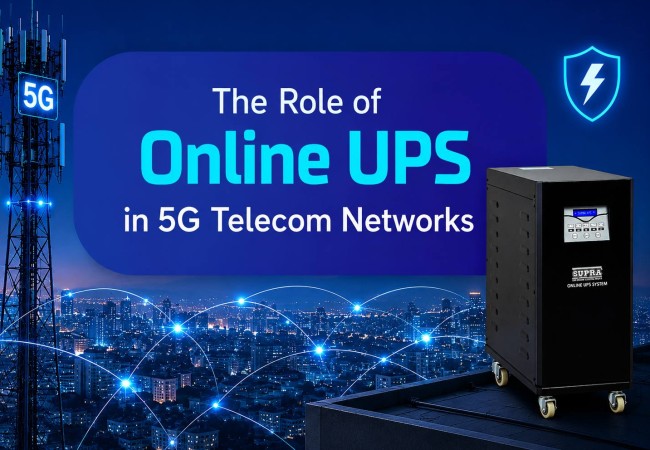
Telecommunications infrastructure quietly supports almost everything, including voice calls, video streaming, cloud services, financial transactions, and an expanding universe of connected devices. As 5G networks continue to roll out across the world, the expectation of constant, uninterrupted connectivity has become the baseline. Against that backdrop, even a brief power disruption can affect thousands of users, knock out critical services, and create operational losses that are difficult to recover from quickly.
Online UPS systems exist precisely to prevent that. For telecom operators, reliable power backup is no longer a contingency measure; it is a core part of keeping the network running.
Why Power Reliability Matters More in 5G Networks
5G infrastructure is fundamentally different from what came before it. It relies on a higher density of base stations, distributed network nodes, edge computing facilities, and high-capacity switching equipment, all working together to deliver the speed and low latency that 5G promises. That complexity comes with a cost: the infrastructure is more sensitive to power instability than earlier generations of mobile networks.
A power failure at a single telecom tower or switching station can affect a wide area. Given that these networks support emergency communications, healthcare applications, and financial services, the consequences of downtime extend well beyond a dropped call.
How an Online UPS Works
An online UPS works differently than a traditional backup system. Instead of waiting for the electricity to go out and then turning on, it is constantly supplying power through its inverter, and at the same time, charging its batteries. This double-conversion approach means there is no transfer delay when the mains supply drops. Equipment simply keeps running.
For telecom applications, this matters. It eliminates the brief interruption that a standard UPS would introduce, protects sensitive networking equipment from voltage spikes and electrical noise, and delivers a stable output regardless of what is happening on the input side.
1. Keeping Base Stations Running
5G base stations carry enormous volumes of data traffic and need to maintain low-latency performance continuously. Even a few seconds of downtime can have a measurable impact on service quality, customer experience, and overall network stability.
An online UPS offers instant, seamless backup power as the mains supply fails, so base stations stay functioning until either the supply is restored or a generator takes over. This type of security is particularly important for remote telecom towers where power reliability is sometimes less steady.
2. Protecting Telecom Data Centres
Telecom companies run large data centres that process and store customer data, host critical applications, and support cloud services around the clock. Power outages in these contexts can result in server shutdowns, data corruption, hardware failures, and prolonged service outages, none of which are acceptable when uptime is the expectation.
An online UPS covers servers, storage systems, networking hardware, and cooling infrastructure so the facility stays running through electrical interruptions. As telecom operators expand into edge computing and cloud services, the importance of that protection only increases.
Read more: How to Select the Right Online UPS for Your Data Center Needs
3. Protecting Switching and Transmission Equipment
Routers, switching systems, transmission equipment, and communication gateways are highly sensitive to voltage irregularities. It is not just outages that cause damage; spikes, sags, surges, and frequency variations all take a toll on hardware over time.
An online UPS addresses this by maintaining a consistently stable power environment, not just by providing backup when the lights go out. The practical result is fewer equipment failures, longer hardware lifespan, and a more reliable network overall.
4. Keeping Up with 5G Power Demands
5G base stations require far more power than older models, and can support a much larger density of linked devices. As networks grow, the power protection architecture has to grow with them.
This is exactly what modern online UPS systems are designed to do. Their modular architecture allows capacity to be added incrementally as requirements rise, and they are designed to maintain excellent energy efficiency even at increased loads, making them a feasible solution for operators aiming for long-term network development.
5. Business Continuity and Customer Trust
For telecom operators, service reliability and business performance are directly connected. Repeated outages damage customer trust, generate complaints, and in competitive markets, drive customers toward alternatives. An online UPS minimises downtime, safeguards equipment, and supports the steady service quality customers want. In a market where uptime is no longer seen as a bonus but is increasingly taken for granted, reliable power protection is a true competitive differentiator.
Learn More: Essential Checklist Before Buying an Online UPS System
Leading Power Backup Solutions from Supra Hi-Tech
Supra Hi-Tech is a manufacturer and supplier of power control and backup solutions with decades of experience in serving industries, enterprises and institutions. We offer a selection of online UPS systems, line-Interactive UPS, servo stabilisers, inverters, solar solutions, and a comprehensive range of power accessories, created with an emphasis on performance, reliability and long-term value. Supra Hi-Tech provides solutions to ensure continued operations in challenging environments for telecom operators and critical infrastructure providers who need reliable power protection.
As 5G continues to reshape the telecom landscape, the fundamentals have not changed; networks need power, and that power needs to be reliable. An online UPS is the most straightforward way to ensure that critical infrastructure remains operational no matter what happens on the grid.