Early inverter technologies were simple power conversion systems which were mainly used in industries where uninterrupted power was critical for operations. With the outburst of digital evolution, dependence on electronic devices has only grown. In this scenario, inverter systems have gradually become an essential component across homes, offices, commercial facilities and industries.
As power consumption continues to rise, the efficiency and reliability of inverter systems have become more important than ever. And the main component determining these factors is the inverter's battery. Among the leading battery technologies used in inverters today, lead-acid and lithium-ion batteries are the top choices in the market. They both store and supply backup power, but they differ greatly in terms of energy efficiency, charging speed, battery lifespan, maintenance requirements, safety and long-term value. This blog explores the major difference between lead-acid and lithium-ion batteries and helps you figure out which batter technology is the most apt for your inverter systems.
Understanding the Importance of Battery Efficiency in Inverters
An inverter essentially converts stored DC power from batteries into usable AC electricity when required. As batteries here act as energy reservoirs, efficiency becomes a critical factor for uninterrupted backup performance.
An efficient battery typically features faster charging capability, longer backup duration, reduced energy loss, battery power delivery, extended operational life and lower maintenance requirements.
What Are Lead-Acid Batteries?
Lead-acid batteries are some of the oldest rechargeable battery technologies used in inverter systems. They store electrical energy using lead plates immersed in a sulphuric acid solution. When the inverter draws power from the battery, a chemical reaction inside the battery releases stored energy in the form of electricity. The inverter recharges the battery and recharges the energy storage process as soon as the power supply comes back online.
These batteries have been used in different inverter systems for decades due to their affordability and availability. Lead-acid batteries are available in two types: flooded lead-acid batteries and sealed maintenance-free batteries.
Even though lead-acid batteries are a popular choice for inverters, they are larger, heavier and slower to charge. Additionally, they require more maintenance compared to newer battery technologies.
What Are Lithium-Ion Batteries?
Lithium-ion batteries are much newer and more sophisticated rechargeable batteries found in today's electronics. They charge and discharge by moving lithium ions between the internal electrodes during the process. Unlike the older battery models, lithium-ions are lighter in nature and are engineered to store more energy.
Lithium-ion batteries are known for their ability to charge faster and discharge more efficiently. This particular feature makes them the ideal option for modern power backup applications. This type of battery is used across smartphones and laptops, electric vehicles, solar energy systems and power backup inverters.
Because of their compact size, low-maintenance requirements, longer lifespan and higher energy efficiency, they have become the most preferred choice for modern inverter systems.
Key Differences Between Lead-Acid and Lithium-Ion Inverter Batteries
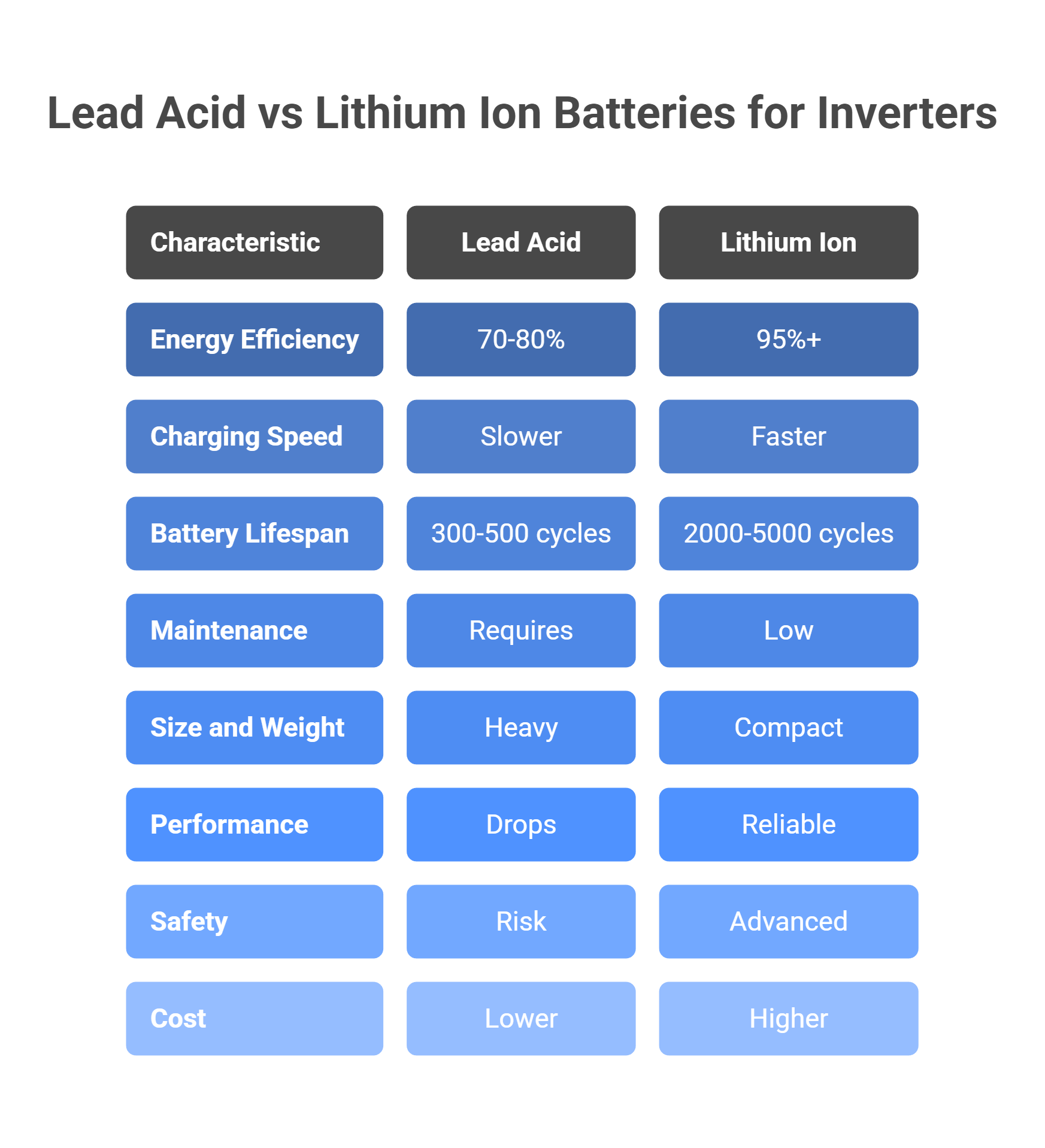
Now that we’ve gone through what lead-acid and lithium-ion batteries are, let us explore the main features that differentiate them:
Energy Efficiency
One of the major factors to consider when looking at inverters is energy efficiency. This characteristic defines the amount of energy that can be extracted from the battery storage. A very efficient battery will minimise energy loss and mean less energy is required to charge and discharge the battery.
As the mainstream choice, the lead-acid batteries operate at around 70% to 80% efficiency. The issue is that this battery loses energy in the form of heat during both charging and discharging. This reduces the overall amount of usable backup power within the inverter.
Lithium-ion batteries are relatively far more energy-efficient and even offer efficiency levels that go beyond 95%. They store and deliver power with minimal energy loss, allowing the inverter to provide longer and more stable performance.
For inverter systems, lithium-ion batteries perform better in terms of energy efficiency. They do this by maximising power utilisation while reducing charging and electricity losses.
Charging Speed and Power Delivery Performance
Another key consideration of an inverter is charge speed. Typical requirements for inverter batteries involve fast recovery from a power outage. Acceleration of charging helps to ensure more robust backup preparedness, especially in regions with more power outages.
The power needed in lead-acid batteries depends on chemical reactions, which means that they need longer charging times. These reactions generally need to be recharged. Furthermore, they also have difficulty with their voltages remaining constant with heavy loads.
Lithium-ion batteries charge significantly faster. They can also deliver stable power even during high-demand scenarios without any issues. They can cover multiple industrial-level appliances more effectively and efficiently.
For inverters, lithium-ion batteries stand as the ideal option, as they recharge faster and provide faster and more stable power at all times.
Battery Lifespan and Charge Cycle
Battery lifespan directly influences the long-term reliability as well as the replacement costs of the inverter. An inverter with a good battery can handle charging and discharging cycles without it affecting the overall performance.
Lead-acid batteries generally offer around 300 to 500 charging cycles before their performance starts dwindling. Frequent use may also shorten their lifespan even faster.
Lithium-ion batteries go beyond by providing between 2000 to 5000 charge cycles, as per their usage conditions and battery quality. They are able to maintain better performance levels for much longer periods when compared to lead-adic alternatives.
In this aspect, lithium-ion batteries are far better due to the reliability and minimal replacement requirements.
Maintenance Requirements
For invertners, maintenance is an important factor that affects their performance, safety and operational life. Inverters with lower maintenance are usually preferred due to more user convenience.
Lead-acid batteries usually require the addition of periodic water, regular cleaning, corrosion checks and proper ventilation. Neglecting such maintenance can reduce efficiency and damage the battery in the long run.
Lithium-ion batteries require very little maintenance compared to alternatives. It is mainly because of their sealed structures and built-in battery management system that is constantly monitoring the battery conditions and performance.
For inverters, lithium-ion batteries are the better choice, as they offer lower maintenance and a hassle-free user experience.
- Space and Weight Advantages of Lithium-Ion Batteries
- Space and Weight Advantages of Lithium-Ion Batteries
Battery size and weight are important aspects of inverter installations. This is particularly important in places where limited space exists.
Lead-acid batteries are larger and heavier, as they need the appropriate space for lead plates and liquid electrolytes. They require larger spaces for installation.
Lithium-ion batteries are more compact, lightweight and capable of storing higher amounts of energy even with smaller space requirements. They are also relatively much lighter, allowing for easy transportation.
For inverters, lithium-ion batteries are the ideal choice, as they make space organisation and transportation much easier.
Performance During Frequent Power Cuts and Heavy Usage
When regular power interruptions are a norm, inverter batteries may have to work overtime and undergo repeated charging and discharging cycles. In such places, invertners must have batteries that are able to maintain stable and reliable performance under continuous usage conditions.
Lead-acid batteries tend to degrade much faster during repeated discharge cycles. Moreover, they tend to lose their efficiency and energy backup performance over time.
Lithium-ion batteries are designed to handle frequent discharging and charging cycles faster and better. They can maintain their regular performance even under demanding conditions.
In this aspect, lithium-ion batteries are the best choice for inverters, as they can face frequent power cuts and instant discharge and charge cycles without any issues.
- Safety Features and Battery Management Systems
- Safety Features and Battery Management Systems
Like any power appliance, safety comes with utmost priority. Inverter battery systems that have the chance to overheat or overcharge can damage the appliances as well as the users.
Lead-acid batteries may face issues such as acid leakage, gas emissions, overheating or sulfation if they are not maintained properly.
Lithium-ion batteries come with advanced and intelligent battery management systems. They constantly monitor voltage, temperature, charging conditions and overall battery health. These systems oversee and make sure that they are safe.
For inverters, lithium-ion batteries provide advanced safety mechanisms for inverter safety and secure operations.
- Cost Comparison: Initial Investment vs Long-Term Value
- Cost Comparison: Initial Investment vs Long-Term Value
Beyond all the discussed factors, the budget stands as one of the most important deciding factors for inverter batteries. However, it is important to consider both initial purchase price and long-term value when choosing a battery.
Typically, lead-acid batteries have lower initial purchase prices. They're inexpensive and are appealing to users who have lower budgets, but they're more expensive in the long run as they require more maintenance. Furthermore, it has a short life span, which makes it even less attractive.
Lithium-ion batteries tend to have higher purchase costs. But they cover these costs by providing better long-term value through a longer lifespan. These batteries come with lower maintenance requirements, reduced energy loss and better efficiency, making them the ideal choice.
When we talk about the budget, lead-acid batteries sound ideal for short-term uses. However, when choosing for long-term inverter performance and value, lithium-ion batteries are the best.
Which Battery Is More Suitable for Commercial and Industrial Inverters?
Smaller commercial setups still use lead-acid batteries because they have limited backup demands and prioritise budgets.
However, for large-scale commercial and industrial applications, lithium-ion batteries are more considered. They offer higher efficiency, faster recovery after discharge and better load-handling capability. Lithium-ion batteries also offer lower maintenance requirements and longer lifespans, making them ideal for demanding environments. Industries operating around the clock benefit from lithium-ion batteries because they provide stable inverter performance even during continuous usage and frequent power fluctuations.
Supra Hi-Tech - Your Top Partner for Best Inverter Technologies
Throughout this blog, we have gone through both lead-acid and lithium-ion batteries and their properties. Lead-acid batteries stand as the most practical solution for users seeking economic backup. On the other hand, when considering factors such as energy efficiency, charging speed, lifespan, maintenance, safety and consistent performance, lithium-ion batteries clearly stand ahead as the ideal option.
As a trusted manufacturer and provider of advanced power control and backup solutions, Supra Hi-Tech offers you the best inverter solutions. We believe that a well-chosen battery contributes to better energy savings and overall long-term operational stability. With decades of expertise in partnering with diverse industries, we specialise in designing and manufacturing high-quality online UPS systems, line-interactive UPS, inverters, servo stabilisers, solar solutions, and related power accessories.
If you are looking for the best inverter systems that fit your requirements, Supra Hi-Tech stands as your partner for trusted power solutions.