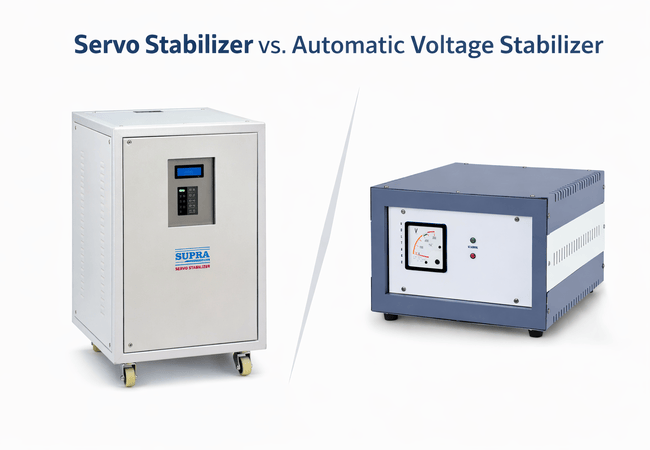
Fluctuations in power supply can damage sensitive electronics irrevocably, and that is where voltage stabilizers come into play. Voltage stabilizers protect sensitive electronics from harmful fluctuations in the power supply, ensuring consistent performance and longevity.
There are primarily two categories of voltage stabilizers - Servo and Automatic, which include relay-based and static stabilizers. Each type serves different requirements based on accuracy, load capacity, response time, and application. Voltage stabilizers maintain a steady output voltage throughout, even in the case of input variations. They help in preventing damage to household appliances like refrigerators and air conditioners, and industrial machinery. Voltage stabilizers are commonly used in regions with unstable grids, and they range from basic relay - based models to advanced servo-controlled systems.
What is a Servo Stabilizer?
A servo stabilizer is an advanced voltage regulation device that uses a servo motor mechanism combined with a buck-boost transformer. It continuously monitors input voltage variations and automatically adjusts the transformer winding to deliver a precise and stable output.
Servo stabilizers are known for:
- High voltage regulation accuracy
- Smooth and continuous correction
- Excellent performance under heavy and fluctuating loads
They are commonly used in environments where voltage precision is critical and even minor deviations can cause operational disruptions or equipment damage.
What is an Automatic Voltage Stabilizer?
An automatic voltage stabilizer regulates voltage using relay switching or solid-state electronic components such as IGBTs.
- Relay-based stabilizers adjust voltage in fixed steps by switching transformer taps
- Static stabilizers use electronic circuitry and pulse-width modulation for faster correction with no moving parts
These stabilizers are compact, efficient, and suitable for residential and light commercial use.
Working Principle Comparison
The primary difference between servo and automatic stabilizers lies in how voltage correction is achieved. While servo stabilizers operate via a feedback loop, automatic stabilizers rely on relay switching for slower and stepped regulation or static electronics, which are faster but less precise for heavy loads.
Voltage Regulation Accuracy
Servo stabilizers offer superior accuracy of ±0.5% to ±1%, ideal for sensitive equipment. Automatic stabilizers provide ±3-5% in relay types and ±1-3% in static versions, sufficient for general household use.
Response Time Differences
Servo models respond within the timespan of 10-50 milliseconds, with motors enabling relatively fast and continuous correction, while relay automatics take 50-300 milliseconds due to mechanical switching, all while static automatics achieve 20-50 milliseconds but may falter under sustained loads.
Load Capacity and Power Handling
Servo stabilizers excel in high-load scenarios, handling 1 kVA to over 1000 kVA for industrial use. Automatic stabilizers suit lower capacities up to 20 kVA, with relays prone to wear under heavy, continuous loads.
Efficiency and Energy Consumption
Servo units consume more power with 2-5% losses due to motor operation but deliver precise regulation. Automatic stabilizers are more efficient with 1-3% losses, especially static types, making them cost-effective for light-duty applications.
Maintenance Requirements
Servo stabilizers require periodic motor and carbon brush checks, with higher upkeep due to mechanical parts. Automatic stabilizers, particularly static ones, need minimal maintenance as they lack moving components.
Durability and Life
Mechanical elements in servos yield 15-20 years lifespan with proper care, though motors wear over time. Static automatics last 20+ years with no moving parts, but relays in cheaper models degrade faster.
Cost Comparison
Servo stabilizers are more on the costlier side. They usually cost up to ₹10,000-₹5,00,000 which differs with its capacity. Meanwhile automatic stabilizers are budget-friendly, costing around ₹2,000-₹50,000, offering better value for homes.
Applications of Servo Stabilizers
Servo stabilizers are widely used in:
- Manufacturing plants and processing units
- Data centers and server rooms
- Hospitals and diagnostic labs
- CNC machines and automation systems
- Medical imaging equipment such as MRI and CT scanners
Read more: The Role of Servo Stabilizers in Industrial Applications
Applications of Automatic Stabilizers
Automatic stabilizers are ideal for:
- Air conditioners, refrigerators, and televisions
- Residential appliances
- Offices and retail spaces
- IT and telecom equipment (static stabilizers)
Which Stabilizer is Better for Industrial Use?
The preferred one for industrial use is servo stabilizer, as they have high accuracy, load handling and are reliable, especially during critical operations. They also help in reducing the downtime in manufacturing and processing plants.
Which Stabilizer is Suitable for Residential and Commercial Use?
Automatic stabilizers fit residential and commercial needs with affordability and ease, handling typical household fluctuations effectively. Opt for static types for modern smart homes.
Key Differences Summary
| Feature | Servo Stabilizer | Automatic Stabilizer |
| Accuracy | ±0.5-1% | ±3-5% (relay), ±1-3% (static) |
| Response Time | 10-50ms | 20-300ms |
| Load Capacity | High (industrial) | Medium (home/commercial) |
| Maintenance | Higher (mechanical) | Lower (static preferred) |
| Cost | Higher | Lower |
Learn more: Top 10 Benefits of Using Servo Voltage Stabilizer
Choosing the Right Stabilizer
Choosing the right stabilizer is crucial for your space no matter if it is your home, office or workspace.
If you're looking for precision - critical and high - load performance for industrial applications, servo stablizer is the ideal choice. Meanwhile if you're looking for a more cost efficient and residential protection, then an automatic stabilizer is the ideal choice.
Supra Hi-Tech, a trusted name in power control and backup solutions for decades, specializes in manufacturing high-quality servo stabilizers, UPS systems, inverters, and solar solutions designed to meet diverse power protection needs. Whether for industrial operations or residential applications, we deliver reliable, efficient, and advanced power solutions.