Did you know that the world’s solar energy capacity crossed 2.2 terawatts (TW) as of 2024? This fast pace of solar installations also made way for greater debate on how solar panel owners are rewarded for the electricity they generate. Two terms which are often used in this context are net metering and net billing. If you are thinking of investing in a solar energy system or already have one, it's crucial to know the difference between these two policies. In this blog, we compare net metering vs net billing, how they work, and assist you in determining which one is better for your installation.
Net Metering vs. Net Billing
What is Net Metering?
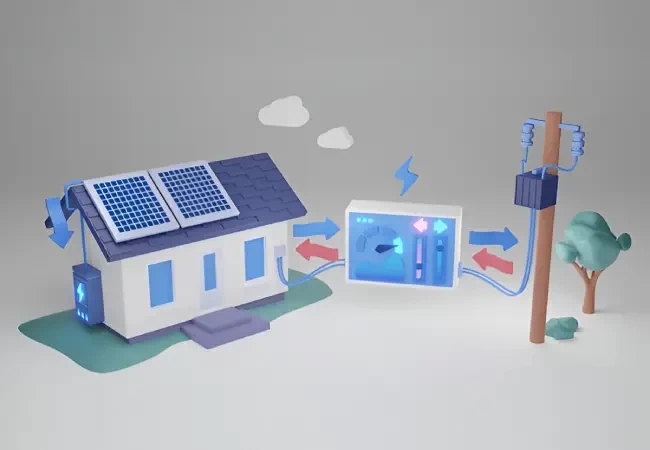
Net metering is a billing arrangement between the owner and the utility company. If your solar panels generate more electricity than your business or home needs, your extra electricity is fed back into the electricity grid. Your utility company provides you with energy credits in exchange, and this can be applied to defray your electricity use when your panels are not generating, such as at night or on cloudy days.
This system is based on a bi-directional electricity meter, also referred to as a net meter, that measures both the electricity you draw from the grid and the electricity you return. If you return more than you use, your electric bill can be significantly reduced or even zero. Some of the key benefits of net metering are:
- Reduces your electric bills month after month
- Makes your solar investment more financially rewarding
- Easy to handle with no storage for batteries
- Encourages efficient solar production by using the grid as a virtual storage system
- Widely adopted for grid-tie solar installations
What Is Net Billing?
Net billing works a bit differently from the other. Similar to net metering, your solar power system feeds excess electricity back into the grid. You will not receive credits at retail rates of electricity, but will receive payments at a fixed rate for the exported energy instead of receiving credits at retail rates. This can be generally lower than the price you pay for electricity from the grid.
When you then use electricity from the grid, you pay at the standard rate. So, although you are saving, your solar return may be slightly lower than under net metering. Some of the major benefits of net billing are as follows:
Allows you to earn money on excess solar electricity
Encourages the use of energy storage devices like solar batteries
Beneficial in regions where net metering schemes are restricted or discontinued
Provides greater flexibility in solar plant operation for large-scale facilities
Net Metering vs Net Billing: Main Differences
Let's discuss the key differences between net metering and net billing so you can easily see how each impacts your solar power consumption and savings.
-
Compensation Method
Net Metering: You earn credits equal to the retail price of electricity. The credits are transferred to your future electricity consumption.
Net Billing: You are paid a fixed amount for each unit of energy exported to the grid. You pay full price for the energy you consume from the grid.
-
Billing Transparency
Net Metering: Your bill shows how much electricity you exported, imported, and how many credits remain.
Net Billing: Your bill shows how much electricity you exported and how much you earned from it. You continue to pay for the electricity consumed thereafter.
-
Impact on Savings
Net Metering generally offers more financial savings for solar panel owners, especially when there is no battery storage involved.
Net Billing can still offer savings, but is often more favourable when paired with an energy storage system to maximize on-site energy use.
-
Use of the Grid
Both systems allow the grid to act as backup, but net metering lets you “bank” energy credits, while net billing involves immediate compensation for surplus energy.
Which option is the best?
The decision to go with net metering or net billing relies on your location, your electric use, and your solar configuration. If your utility company supports net metering and your power consumption is stable, this option will likely give you more savings. It’s especially suitable for residential rooftop solar systems. On the other hand, if your state or provider offers only net billing, pairing your solar installation with battery storage can help you get the most value. That way, you can use stored energy during peak hours rather than relying on costly grid power.
Future of Solar Energy
With advancing technology and decreasing costs, an increasing number of nations are incorporating solar power into their energy strategy. Be it large-scale solar farms or in-home rooftop installations, solar is becoming easier and cheaper for all to own and install. Governments and companies across the world are heavily investing in solar installations to cut the reliance on fossil fuels and meet climate targets. Advances in battery storage, smart inverters, and solar tracking systems also contribute to improved efficiency as well as reliability.
As more people understand the benefits of clean and renewable energy, solar adoption is expected to rise sharply in the coming years. From powering remote villages to supporting modern cities, solar energy is playing a major role in shaping a sustainable future for the planet.
Supra’s Solar Solutions
Whether one is planning an on-grid solar setup or an independent setup, Supra Hi-Tech has dependable and performance-oriented solar solutions that suit different weather conditions.
-
On-Grid Solar Systems
Supra’s on-grid solar systems are ideal for homes and businesses connected to the main electricity grid. Our on-grid solar systems include high-efficiency solar inverters and smart monitoring possibilities.
These are a perfect option for reducing your utility bills. Depending on the local policy, you may be able to utilize net metering, net billing, or both, depending on your needs. The advantages of our on-grid solar systems include:
- Seamless grid integration
- Excellent conversion efficiency
- Savings on cost
- Simple maintenance & long-lasting durability
- Good after-sales support
- No battery storage is required
-
Off-Grid Solar Systems
If you live in a remote area or want complete independence from the grid, Supra’s off-grid systems are a solid choice. When you invest in an off-grid solar system, you will receive a backup battery system that will be able to provide you with power. So, power is available even when the sun is not shining enough or in case of a power outage.
- Perfect for areas without access to the grid
- Provides a 24/7 power supply
- Ideal for farms, villas, and remote facilities
- Durable, smart, and built for Indian weather
Conclusion
To get the most from your solar investment, it is crucial that you know the difference between net metering and net billing. So, you might have understood that both models have their advantages, and both are suitable for a wide range of energy needs. Whichever is your choice, it is best to have a dependable solar system. Supra Hi-Tech offer dependable on-grid and off-grid solar systems that can save your power bills and ensure efficient performance. For more information, visit our website and explore our solar systems.