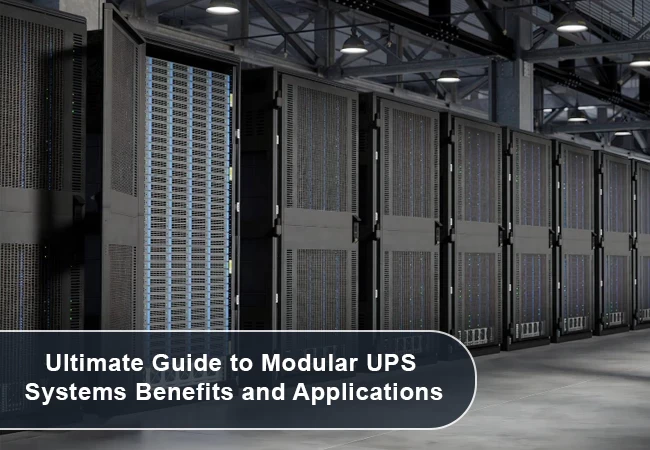
There is no doubt that power outages are more than mere inconveniences in today's digital-first world. This is a direct threat to the operations, productivity, and the bottom line of your business. The reliability of a power supply is crucial to the success of any business, whether it is for servers, computer systems, or critical network infrastructure. When the power fails, operations can halt, data might be lost, and your customer-facing services could go offline. There are many costs associated with this type of disruption, in addition to the money that you lose.
It is for this reason that maintaining a reliable Uninterruptible Power Supply (UPS) is an essential part of any modern business. There are several types of UPS available, but this is a modular UPS that may be the most suitable for your needs. In this blog, we will explain what a modular UPS is and why more businesses are switching to them.
What is a Modular UPS?
A modular UPS is a power backup system designed using a flexible architecture. The system is simply not made of a single unit, but rather of several independent modules, each of which serves a specific function within the system. These modules can include power modules, intelligence modules, static bypass modules, battery modules, and distribution modules.
Each module is designed to be easily replaceable, scalable, and in many cases, hot-swappable. This means you can service or upgrade the system without shutting it down, and this is so important in today's always-on business environment.
Key Components of a Modular UPS
Understanding the role of each module helps you see why modular UPS systems are so powerful.
-
Power Module
This is the engine of the UPS and is responsible for converting as well as delivering power to your systems. Most modular UPS systems include multiple power modules. One major benefit here is redundancy. For example, if your system is configured with N+1 redundancy, it means that even if one power module fails, the others can take over without interruption.
Some power modules offer "live swap" features, meaning you can replace them while the system runs. This dramatically reduces downtime and makes maintenance a lot easier.
-
Intelligence Module
This is essentially the brain of the UPS. It controls the operation of all the other components and communicates with external systems. Because it's modular, it can also be replaced quickly if it fails. Some systems even allow a secondary intelligence module for backup, which adds another layer of reliability.
-
Static Bypass Module
Static bypass modules provide direct power from the power source to the load in the case of UPS failure or UPS service downtime. When this module is designed to be modular, it means you can replace or service it in minutes without affecting uptime.
-
Battery Modules
Battery modules store the energy that powers your devices during an outage. Battery cartridges are used in modular UPS systems, which make it easy for the user to install and replace batteries as needed. You can add extra modules for a longer backup time or to increase redundancy. Many battery modules support features like self-detection and health monitoring.
-
Distribution Modules
These modules handle how power is distributed from the UPS to your systems. Modular design lets you easily expand or reconfigure your power distribution, and will be helpful as your business grows or changes.
Benefits of Modular UPS Systems
-
Scalability
Need more power as your business expands? With a modular UPS, you can add more power modules instead of replacing the whole system. This makes it a future-ready solution that grows with you.
-
Improved Redundancy
Modular systems support configurations like N+1 redundancy. As a result, if one module fails, the others will take over to ensure that the system continues to function. This improves uptime and gives you peace of mind, especially in critical environments like data centers or hospitals.
-
Faster Maintenance and Repairs
Because modules can be removed and replaced in minutes, service time is dramatically reduced. It is not necessary to shut down your entire system in order to replace a faulty part.
-
Reduced Downtime
Live Swap is one of the features that allows modules to be swapped without any interruptions to the system. This means zero scheduled downtime for maintenance or upgrades.
-
Better Energy Efficiency
Modular systems often allow for load optimization. In cases where the power needs of your system are low, you can run fewer modules, lowering the energy consumption as well as the cost of the system.
-
Space-Saving Design
Instead of installing multiple traditional UPS systems, a modular UPS can be compact and occupy less floor space. You only need to install what you need and add more modules later.
-
Flexibility
Whether your organization is growing or changing its infrastructure, a modular UPS allows you to adapt without needing a complete overhaul.
Applications of Modular UPS
Modular UPS systems are ideal in various industries and some of the most common applications include:
-
Data Centers
Downtime in a data center can be catastrophic. Modular UPS ensures that backup power is always ready and can be maintained without taking systems offline.
-
Hospitals
It is very important to maintain power in hospitals, because power interruptions can put the lives of patients at risk. Modular UPS systems offer the reliability as well as redundancy that is needed to keep critical equipment running.
-
Banking and Finance
These sectors require uninterrupted power to support transactions, servers, and secure data. A modular UPS is a smart investment to ensure 24/7 operations in the banking and finance sector.
-
Manufacturing and Industry
It is important to note that even short outages can cause disruptions in production lines. There are modular UPS systems that are designed to provide continuous power and protect sensitive machinery against electrical fluctuations.
-
Offices and Commercial Buildings
A power backup is now a crucial part of any office environment due to the rise of remote servers, smart systems, and IoT devices. Modular UPS systems provide the right mix of reliability and scalability.
Things to Consider Before Choosing a Modular UPS
Before installing a modular UPS system, keep these factors in mind:
Power requirements: Know how much load your system needs to support.
Redundancy level: It is important to decide whether you require N+1 configurations or higher configurations.
Physical space: Calculate how much space is needed for the installation of the UPS system.
Maintenance and service support: Make sure you choose a service provider that offers quick module replacements and quick repairs.
Modular UPS vs Traditional UPS
There is no doubt that traditional UPS systems are still widely used today, but they are not as flexible, scalable, and serviceable as modular UPS systems. This is mainly because traditional UPSs have limitations on flexibility and scalability. When it comes to traditional UPSs, they usually have a fixed capacity and are harder to maintain without shutting the system down completely. Apart from these, modular UPS systems allow you to expand power as your needs grow, replace components easily, minimize downtime, as well as increase energy efficiency
Conclusion
There is a growing demand for innovative, scalable, and efficient backup power systems as most businesses move toward digital operations. A modular UPS gives you the flexibility to grow, adapt, and protect your critical systems without the limitations of a traditional one.
If you own or manage a data center, a hospital, an office, or anything else that relies on uninterrupted power, a modular UPS is a smart investment that you should make for better and smarter operations.
Top-Notch Modular UPS Systems
Advanced modular UPS systems can be customized for different purposes, including residential, commercial, and industrial use. As a leading and trusted UPS manufacturer, Supra Hi-Tech understands and provides the best UPS solutions for different industries. Get in touch with Supra today to learn more about UPS systems.