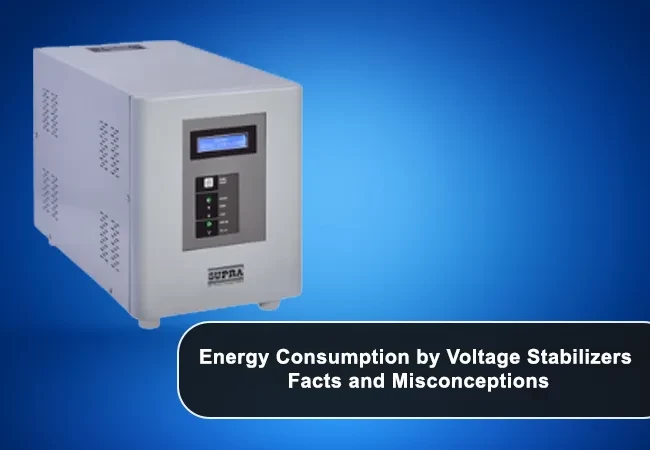
Nowadays, most of us focus on energy efficiency and rising electricity bills, and every appliance in our home or business comes under close examination. In our homes, we often come across different devices, and one question that frequently comes up is does a stabilizer consume electricity? And of course, there is a mix of facts and misconceptions circulating on this topic. We want to make sure it doesn't quietly add hefty costs to our monthly power bills while protecting our valuable electronics. For most people, the advantages it offers far exceed the small amount of electricity it consumes.
The Role of a Voltage Stabilizer
Before we discuss more about energy use, it is important to know what a voltage stabilizer does and remember that the electricity supply isn't always perfectly stable. In many regions, you will experience voltage fluctuations when the incoming electricity is either too high (voltage surge) or too low (voltage dip).
- It is very important to understand that too high voltage can permanently damage sensitive electronics, reduce their lifespan, as well as even pose fire risks.
- At the same time, too low voltage can cause appliances to malfunction, overheat (especially motor-driven ones like refrigerators and ACs), or simply not work at all.
A voltage stabilizer acts as a protector, takes this unstable input voltage and automatically adjusts it to provide a consistent, safe, as well as reliable output voltage (usually 220V or 230V) for connected appliances. As you might know, this protection is very invaluable for expensive and sensitive equipment.
Does Stabilizer Consume Electricity?
A voltage stabilizer does use some electricity to work, just like other electrical devices. However, it doesn't use much power compared to the electrical devices it protects. Here are the sources of this consumption:
Internal Working Losses (The Transformer and Electronics)
Most voltage stabilizers have a transformer, along with control circuitry.
-
Transformer Losses
When electricity flows through a transformer, a bit of energy gets lost as heat. This happens because of things like the resistance in the copper wires as well as some magnetic losses in the center. Please note that even when nothing is plugged in, the transformer still uses a small amount of power to keep its magnetic field active.
-
Control Circuitry
The electronic circuits that monitor the input voltage, decide on adjustments, and control the servo motor (in servo stabilizers) also require a small amount of electricity to function.
It is important to note that this energy consumption is continuous as long as the stabilizer is switched on and connected to the mains. And the same happens even if there is a voltage fluctuation or not.
Servo Motor Operation (for Servo Stabilizers)
If it is a servo voltage stabilizer, it uses a small motor to mechanically adjust the transformer taps.
-
Intermittent consumption
This servo motor only draws power when it needs to operate, that is, when there is a voltage fluctuation that requires adjustment.
Efficiency
Stabilizers have an efficiency rating, usually expressed as a percentage. This percentage shows how much of the input power is delivered to the output, how much power is lost internally as heat, etc.
-
Higher efficiency means lower consumption
A stabilizer with 95% efficiency will waste less energy internally than one with 90% efficiency. This means less power is drawn from your main supply just for the stabilizer's own operation. High-quality stabilizers from reputable manufacturers are designed, and manufactured for the best efficiency.
Facts and Misconceptions
Misconception 1: “Stabilizer uses electricity even when appliances are off!”
Fact: Yes, it does. As explained above, the internal components (transformer, control circuits) are active as long as the stabilizer is powered on. However, this "no-load" consumption is very low, usually just a few watts. In most cases, it will not affect your bill unless you are extremely sensitive to the number of watts you consume.
Misconception 2: "The stabilizer consumes electricity proportional to the appliances connected."
Fact: Not directly. The stabilizer uses only a small amount of power for its own functions, which is a small fixed amount along with a slight percentage of the power it channels to your appliances. It's not designed to increase the power consumption of your devices, it ensures they get the steady power they need to run smoothly. Since those energy losses are based on the total power flowing through the stabilizer, connecting more appliances will lead to a slight increase in those losses as well.
Misconception 3: "Stabilizers save electricity by regulating voltage."
Fact: It's completely normal to be confused about this. Stabilizers don’t actually save electricity by lowering the power your appliances use. In fact, they do add a small amount of consumption of their own because they need power to operate. So, while they help ensure appliances run smoothly, they won’t decrease overall electricity usage.
However, these voltage stabilizers help to save money in other ways:
Preventing Appliance Damage
This is the biggest saving, and replacing a burnt-out TV or refrigerator due to voltage fluctuations is far more expensive than the electricity consumed by the stabilizer.
Ensuring the Best Performance
Appliances, especially motor-driven ones like ACs and refrigerators, run more efficiently and consume less power themselves when they receive stable voltage. Unstable voltage can cause them to work harder, overheat, and actually consume more power or break down. So, indirectly, a stabilizer helps your appliances run as intended and prevents wasteful operation.
Maximizing Benefits & Minimizing Consumption
If you want to get the maximum benefit from your stabilizer, you must:
Choose high-quality, branded stabilizers with good efficiency ratings.
Ensure your stabilizer's capacity (VA or kVA) matches the total load of the appliances you want to protect. An undersized stabilizer will struggle and might get damaged as an oversized one might have slightly higher idle consumption than necessary.
Good airflow helps dissipate heat, allows it to operate more efficiently and last longer.
If you have a solar power system, you can set up your stabilizer to use energy from the sun during the day. This means that its power usage doesn't cost anything during those hours, and this save money while using solar energy!
Why Modern Stabilizers Are Essential
Power fluctuations are not rare in many regions, and it is also important for us to understand the fact that they are a part of everyday life in these areas. Sudden voltage spikes can occur due to many reasons like weather changes, grid switching, or heavy electrical load in the neighbourhood. These fluctuations in the voltage supply directly impact the performance of the various home and industrial appliances. At the same time, power fluctuations can lead to irreversible damage as well, especially in severe cases. When it comes to modern stabilizers, they come with advanced surge protection features that keep sensitive equipment safe. Modern stabilizers are designed to ensure steady output even when the input varies.
Be it a single-phase voltage stabilizer for home appliances or a three-phase voltage stabilizer for commercial and industrial setups, the main purpose remains the same. It is to deliver a consistent power level that prevents overloading as well as overheating. While stabilizers do have a small amount of electricity consumption for operating their internal components, the cost is negligible compared to the massive savings gained by avoiding equipment repairs or replacements. They also help appliances run at their best efficiency, and this indirectly lower electricity costs over time.
If you want dependable protection against voltage spikes and unstable voltage supply, make sure to invest in a high-quality stabilizer.
Conclusion
So, does stabilizer consume electricity? Yes, it does consume a small amount, but you don’t need to worry about it causing a big rise in electricity bill. This minor energy use is really worth it for the protection it provides to valuable and delicate electronics. By keeping appliances safe from voltage fluctuations, the stabilizer helps them last longer and perform better. In a nutshell, this helps to save from the much bigger expenses and hassles of repairs or replacements later on.
A voltage stabilizer is an investment in the long-term health of your electronics. Protect your valuable appliances with cutting-edge technology and ensure consistent power supply. To know more about a range of high-efficiency air-cooled servo stabilizers and oil-cooled servo stabilizers, please get in touch with Supra Hi-Tech.
Frequently Asked Questions (FAQ)
Q: What is the average power consumption of a voltage stabilizer for home use?
A: The average power consumption of a voltage stabilizer for home use is around 5 to 15 watts of power, depending on their size and efficiency.
Q: Do voltage stabilizers consume electricity even when no appliances are connected?
A: Yes. A voltage stabilizers consume a small amount of power to keep its internal components active, even when no appliances are plugged in.
Q: Are there any voltage stabilizer models with smart energy-saving features?
A: Yes. There are modern stabilizers include advanced control systems, higher efficiency ratings, and smart standby modes that help reduce unnecessary electricity consumption.