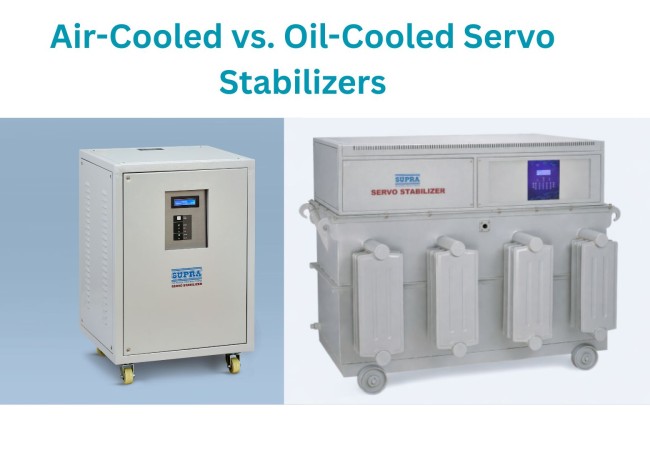
Voltage fluctuations are a common challenge in industrial and commercial environments. Sudden spikes, dips, or unstable power supply can damage sensitive equipment, reduce operational efficiency, and increase maintenance costs. This is where servo stabilizers play an important role. But when choosing a stabilizer, many facility managers face a key question: Should you choose an air-cooled or an oil-cooled servo stabilizer? Let’s explore both options in detail to help you determine the right solution for your facility.
What is a Servo Voltage Stabilizer?
A servo voltage stabilizer is an advanced electromechanical device that maintains a constant output voltage despite wide fluctuations in input voltage. A servo motor mechanism continuously monitors voltage levels and makes necessary adjustments.
Unlike conventional stabilizers, servo stabilizers provide accurate voltage correction and are widely used in industries where consistent power is critical for machinery, automation systems, and production lines.
Learn More: What Does a Stabilizer Do? Types and Their Unique Functions
Key Benefits of Using a Servo Voltage Stabilizer in Industrial Facilities
Integrating a servo stabilizer into your facility offers several benefits:
Precision: Provides a highly stable output voltage, protecting sensitive components.
Efficiency: High efficiency ensures minimal power loss during the stabilization process.
Durability: Built to handle high inrush currents and continuous operation.
Versatility: Able to manage wide input voltage ranges, making them ideal for areas with poor power quality.
Industries such as manufacturing, healthcare, IT infrastructure, printing, textiles, and packaging rely heavily on servo stabilizers for uninterrupted operations.
What is an Air-Cooled Servo Stabilizer?
Air-cooled servo stabilizers utilize natural air convection or forced air (fans) to regulate the temperature of the internal transformer. These units are usually more compact and are housed in ventilated cabinets. They are the most common choice for indoor applications where space is a premium and the environment is relatively clean.
Key Features of Air-Cooled Stabilizers
Compact Design: Without the need for a heavy oil tank, these units occupy a smaller footprint.
Ease of Inspection: All components are easily accessible for visual checks and routine maintenance.
Low Weight: They are much lighter than their oil-cooled counterparts, making them easier to install on upper floors or mezzanine levels.
Eco-Friendly: There is no risk of oil leaks or the need for oil disposal/filtration.
Industrial Applications of Air-Cooled Stabilizers
Air-cooled stabilizers are widely used in:
- Small and medium-scale industries
- Office buildings
- IT and server rooms
- Medical facilities
- Laboratories
- Educational institutions
- Retail outlets
They are ideal for applications where power demand is stable and moderate.
Also read: Why Servo Stabilizers Are Essential for CNC Machines
Advantages of Air-Cooled Stabilizers
Cost-Effective: Generally lower in initial purchase price for low-to-medium KVA ratings.
Low Maintenance: No need to check oil levels, test dielectric strength, or worry about leaks.
Fire Safety: Since there is no flammable oil involved, they are often preferred in buildings with strict fire codes.
Faster Serviceability: Since the internal parts are not submerged, repairs can be carried out more quickly.
What is an Oil-Cooled Servo Stabilizer?
Oil-cooled servo stabilizers are heavy-duty units where the transformer and internal components are submerged in a tank filled with transformer oil. This oil serves a dual purpose: it acts as a superior coolant to dissipate heat and provides electrical insulation. Because of their robust thermal management, these units are typically designed for high-capacity loads and harsh environments.
Key Features of Oil-Cooled Stabilizers
- High Thermal Mass: The oil absorbs heat quickly and dissipates it through the tank's surface or external radiators.
- Sealed Environment: Since the components are submerged, they are protected from dust, humidity, and corrosive gases.
- Higher Capacity: Generally available in much higher KVA ratings (up to 2000 KVA or more) compared to air-cooled units.
- Quiet Operation: The oil acts as a sound dampener, reducing the hum produced by the transformer.
Industrial Applications of Oil-Cooled Stabilizers
Due to their rugged nature, oil-cooled stabilizers are found in:
- Large Manufacturing Plants: Where heavy machinery creates significant heat and vibration.
- Textile Mills: Areas with high levels of dust and lint that would clog air filters.
- Outdoor Installations: Facilities where the unit might be exposed to the elements.
- Mining and Construction: Locations with high ambient temperatures and grit.
Advantages of Oil-Cooled Stabilizers
- Longevity: Better cooling translates to less thermal stress on the copper windings, extending the life of the unit.
- Overload Capacity: They can handle short-term overloads more effectively because the oil provides a thermal buffer.
- Maintenance in Harsh Areas: Since the core is sealed, there is no risk of internal short circuits caused by external debris.
Oil-Cooled vs Air-Cooled: Comparison Table
The table below should provide you a complete comparison between the oil-cooled and air-cooled stabilizers.
| Parameter | Oil-Cooled Stabilizers | Air-Cooled Stabilizers |
| Cooling Medium | Transformer Oil | Natural/Forced Air |
| Load Capacity | High (100-2000+ KVA) | Medium (5-500 KVA) |
| Durability/Heat Handling | Excellent for harsh, continuous use | Moderate for indoor/clean setups |
| Maintenance | Oil checks/filtering | Dust/fan cleaning |
| Size/Weight | Larger, heavier | Compact, lightweight |
| Cost | Higher initial, better long-term ROI | Lower upfront |
| Applications | Large industries | Offices & SMEs |
| Lifespan | Very High | Moderate to High |
Air-Cooled vs. Oil-Cooled Stabilizer: Which One Should You Choose?
The answer depends entirely on your specific environment and load requirements.
Choose Air-Cooled if:
- Your facility is indoor and climate-controlled
- You have limited floor space
- Your load requirements fall within the low-to-medium range
- Environmental cleanliness is high (e.g., pharmaceuticals or electronics)
Choose Oil-Cooled if:
- You are running heavy industrial loads (1000 KVA+)
- The ambient temperature in your facility is consistently high
- The environment is dusty, humid, or contains chemical fumes
- The unit will be placed outdoors or in an unventilated area
Choosing the Right Servo Stabilizer for Long-Term Power Protection
Choosing the right servo stabilizer is an important investment in the long life of your equipment. Air-cooled units are easy to use and save money, making them better for cleaner environments. Oil-cooled stabilizers, on the other hand, are tough enough to handle the toughest industrial jobs.
For those seeking the highest standards in power quality, Supra Hi-Tech stands as a premier partner. As a leading manufacturer and provider of advanced power control and backup solutions, Supra Hi-Tech has been trusted for decades across industries, businesses, and homes. Supra Hi-Tech makes sure your facility stays powered, safe, and productive by specializing in high-quality power products like precision servo stabilizers, online UPS systems, and solar solutions.